

Whether it is for better or worse, we all have a vision—an opinion on the many different ways the world could be improved.
Ask anyone for their vision of a better world, and there is a high probability they will describe a utopia where humanity truly loves and understands one another. Ask that same person for a map to reach that utopia, and that certainty quickly dissolves—you may as well hear a pin drop.
There are, however, a few exceptionally realistic thinkers—what one might call the school of post-humanism—whose vision of utopia is not built by contemporary society, but instead arises from its demise.
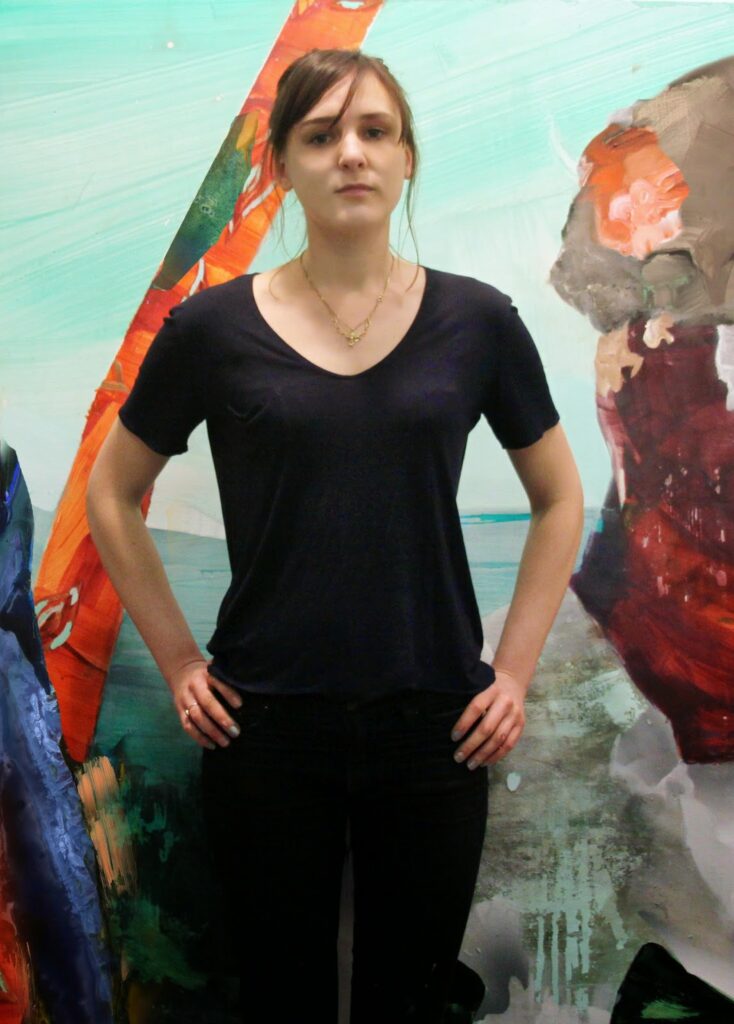
In her first New York City solo exhibition at the P·P·O·W Gallery in Chelsea, titled All This Happens, More or Less, artist Elizabeth Glaessner invites us into a striking and imaginative vision of a post-human utopia.
Using a mixture of water, acrylics, oil paints, and inks, Glaessner constructs a world beyond the existence of modern humanity. Her paintings are saturated with the carnage of today’s society, yet within the same brushstroke, they evoke a sense of exhilaration and hope.
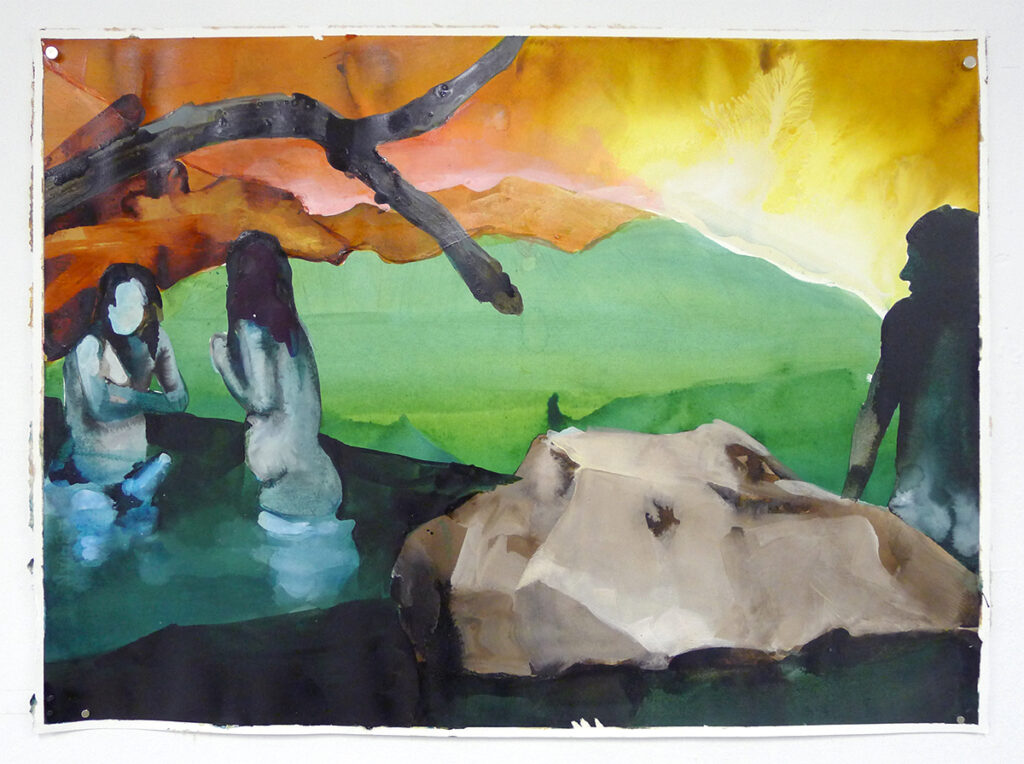
Morning Swim
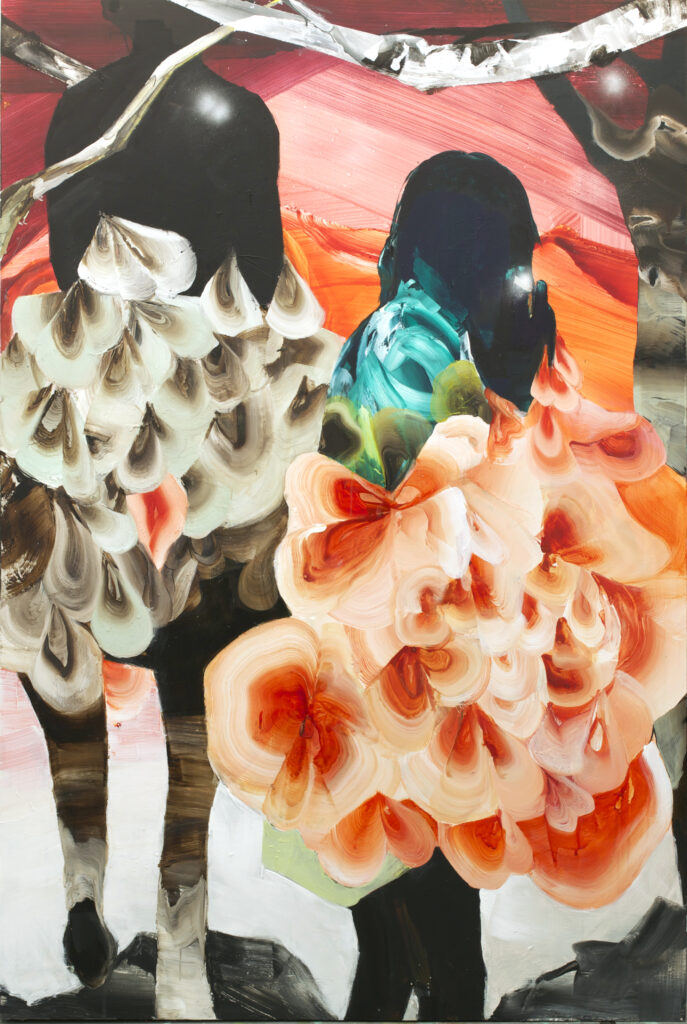
In Morning Swim, Glaessner introduces the viewer to a trio of faceless bathers. Two appear to enjoy a small, toxic body of water, while the third stands to the right, watching the sunrise in quiet awareness.
The golden light suggests the emergence of new life—life that has adapted to this post-human, poisoned world. What is most compelling is the absence of despair. Despite the implied destruction, there is no visible sorrow or death—only a sense of possibility.
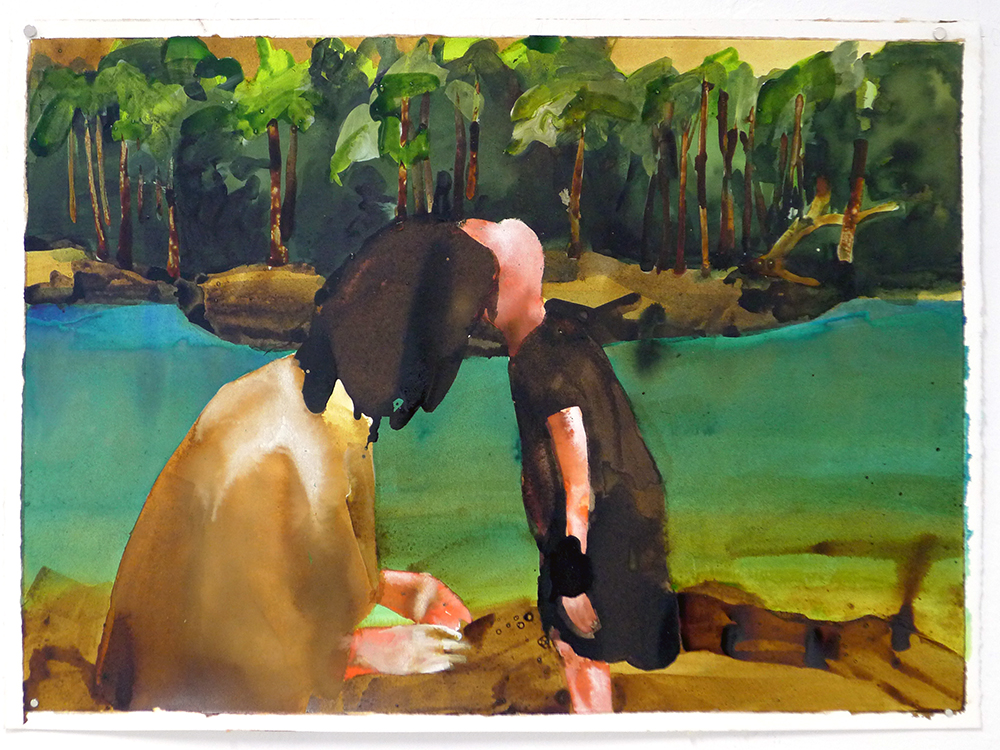
Trampoline Ritual
In Glaessner’s post-human landscape, the remnants of human existence have transformed into sacred relics.
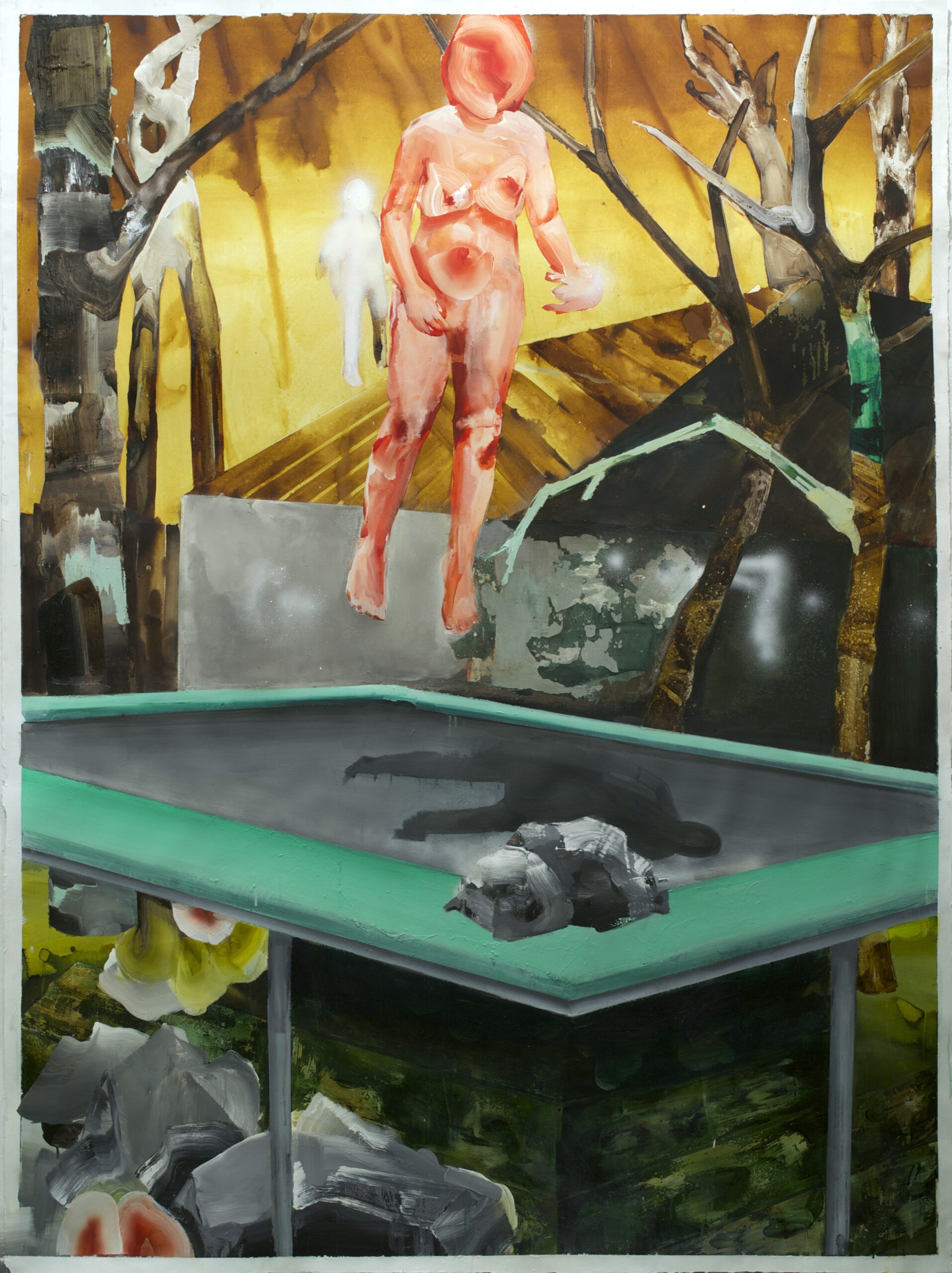
In Trampoline Ritual, a faceless, human-like creature engages with a trampoline in what feels like a ceremonial act. The interaction evokes a lost innocence—something both familiar and entirely recontextualized.
Through her use of split and complementary color, Glaessner once again creates a visual language that leans toward hope, even within strangeness.
Loneliest Nonfunctional Boat
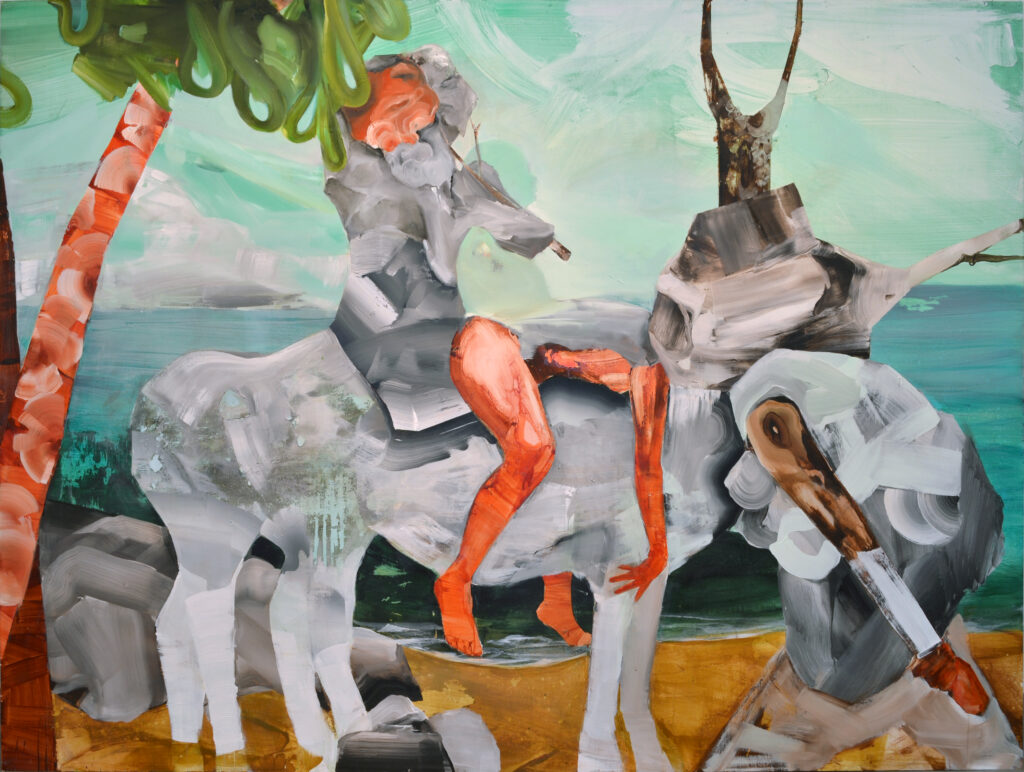
In Loneliest Nonfunctional Boat, the viewer is placed within a muted, gray atmosphere.
A solitary object floats in still water, reinforcing the quiet aftermath of collapse. This piece acts as a reminder that the world depicted throughout the exhibition is born from the destruction of our own.
Process & Narrative
Water is a recurring element in Glaessner’s work—both as a visual motif and as a physical force in her process.
“Water takes on a life of its own in the process of my creations,” she explains.
When asked about her process, Glaessner notes that everything begins with a story:
“No one knows my storytelling more than my sister. I used to keep her up all night with them when we were kids. These days, I keep myself up.”
Although she has attempted to write these stories down, she finds that doing so diminishes their power:
“It’s as though I’ve given them life on paper, and there’s no need to tell the same story twice. They lose their importance to be painted.”
Characters such as Celeste, Donkey Face, Serpentine, and Milk Maiden all originate from these internal narratives, each carrying its own personality and emotional weight.
Final Thoughts
Elizabeth Glaessner’s post-humanist surrealism is deeply original. Her work stands apart from much of today’s contemporary art—not because it seeks attention, but because it resists it.
There is a clear reverence for artistic tradition, yet her work never feels derivative. Where many artists lose themselves in imitation, Glaessner maintains a distinct and evolving voice.
While many pieces within the exhibition radiate optimism, they also carry an undercurrent of warning. The creatures and landscapes she presents reflect not only what could emerge after humanity—but what we continue to ignore in the present.
And perhaps that is the most unsettling element of all.
For more information on Elizabeth Glaessner’s work, please contact the P·P·O·W Gallery or visit:
www.ppowgallery.com
All images are courtesy of the artist and P·P·O·W Gallery.


You’re so cool! I don’t think I have read something like this before. So wonderful to find someone with genuine thoughts. Seriously.. thanks for starting this up. This web site is one thing that’s needed on the internet, someone with a bit of originality!
Hello one of my friends, Your Astella 8 *.