Whether it is for better or worse, we all have a vision—an opinion on the many different ways the world could be improved.
Ask anyone for their vision of a better world, and there is a high probability they will describe a utopia where humanity truly loves and understands one another. Ask that same person for a map to reach that utopia, and that certainty quickly dissolves—you may as well hear a pin drop.
There are, however, a few exceptionally realistic thinkers—what one might call the school of post-humanism—whose vision of utopia is not built by contemporary society, but instead arises from its demise.
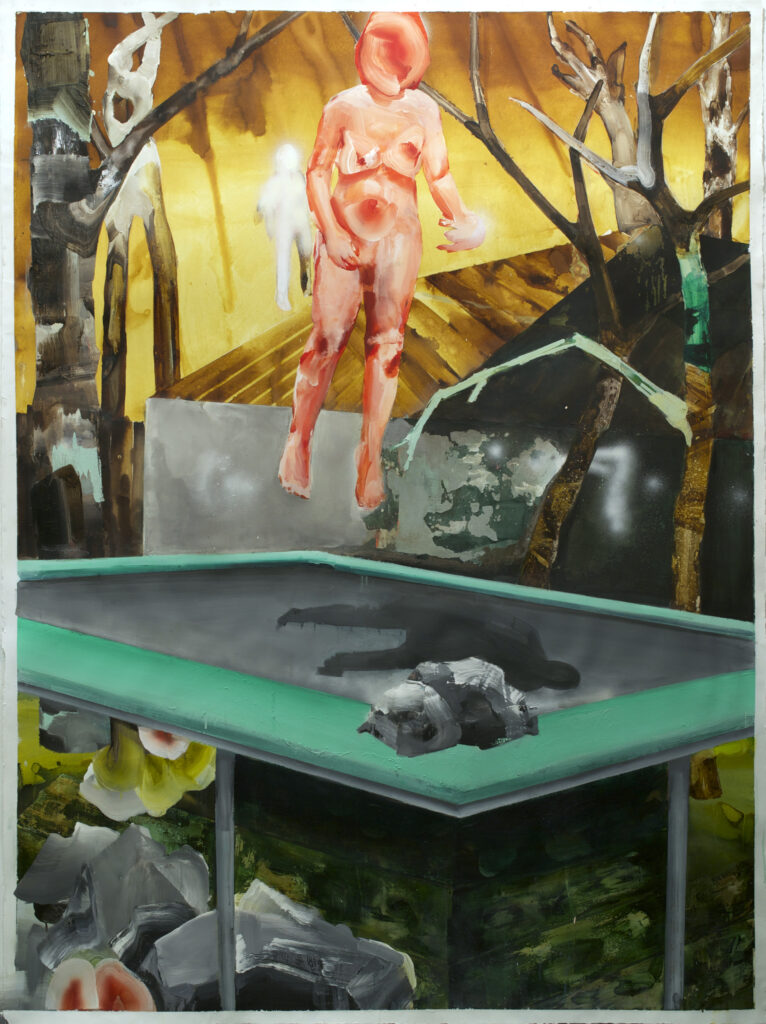
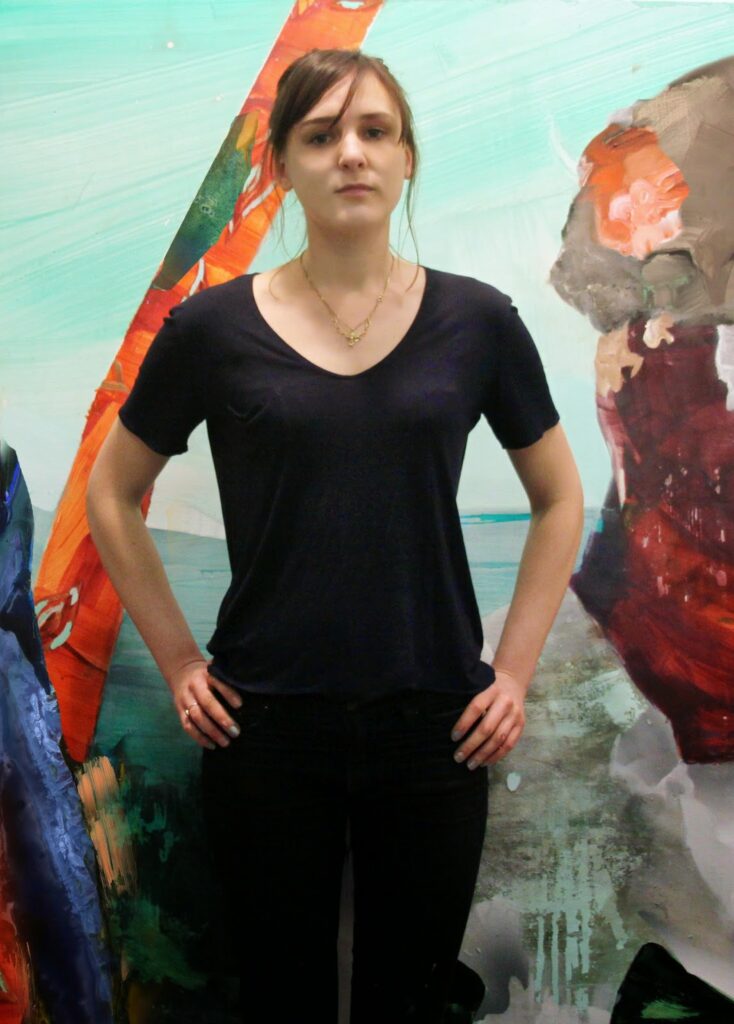
In her first New York City solo exhibition at the P·P·O·W Gallery in Chelsea, titled All This Happens, More or Less, artist Elizabeth Glaessner invites us into a striking and imaginative vision of a post-human utopia.
Using a mixture of water, acrylics, oil paints, and inks, Glaessner constructs a world beyond the existence of modern humanity. Her paintings are saturated with the carnage of today’s society, yet within the same brushstroke, they evoke a sense of exhilaration and hope.
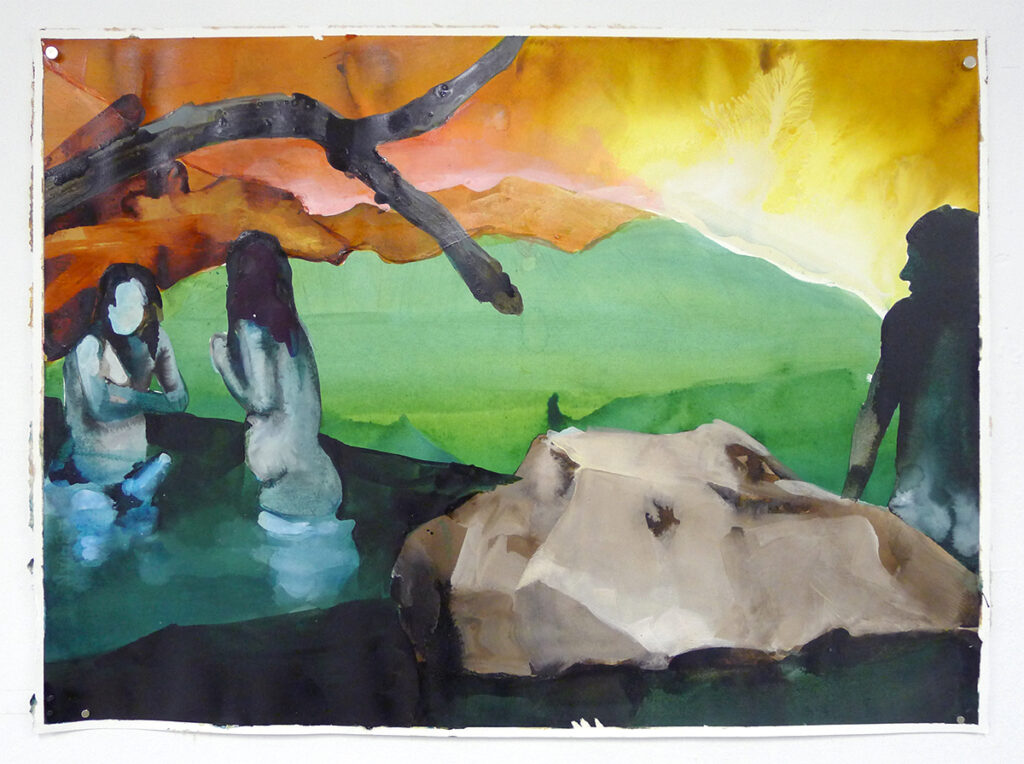
Morning Swim
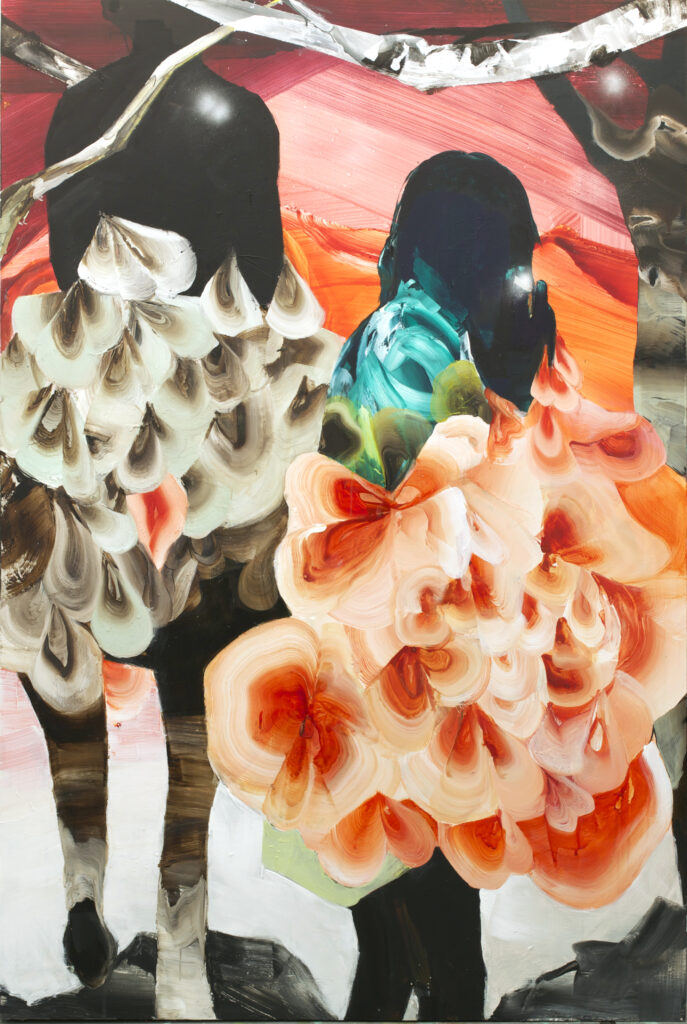
In Morning Swim, Glaessner introduces the viewer to a trio of faceless bathers. Two appear to enjoy a small, toxic body of water, while the third stands to the right, watching the sunrise in quiet awareness.
The golden light suggests the emergence of new life—life that has adapted to this post-human, poisoned world. What is most compelling is the absence of despair. Despite the implied destruction, there is no visible sorrow or death—only a sense of possibility.
Trampoline Ritual
In Glaessner’s post-human landscape, the remnants of human existence have transformed into sacred relics.
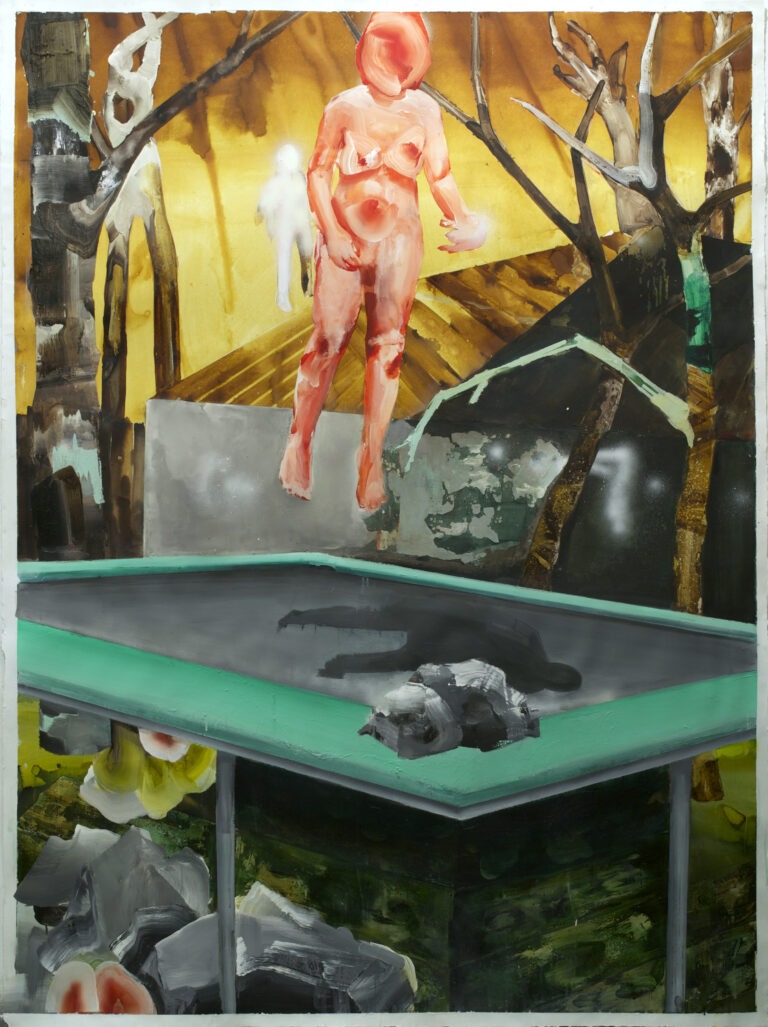
In Trampoline Ritual, a faceless, human-like creature engages with a trampoline in what feels like a ceremonial act. The interaction evokes a lost innocence—something both familiar and entirely recontextualized.
Through her use of split and complementary color, Glaessner once again creates a visual language that leans toward hope, even within strangeness.
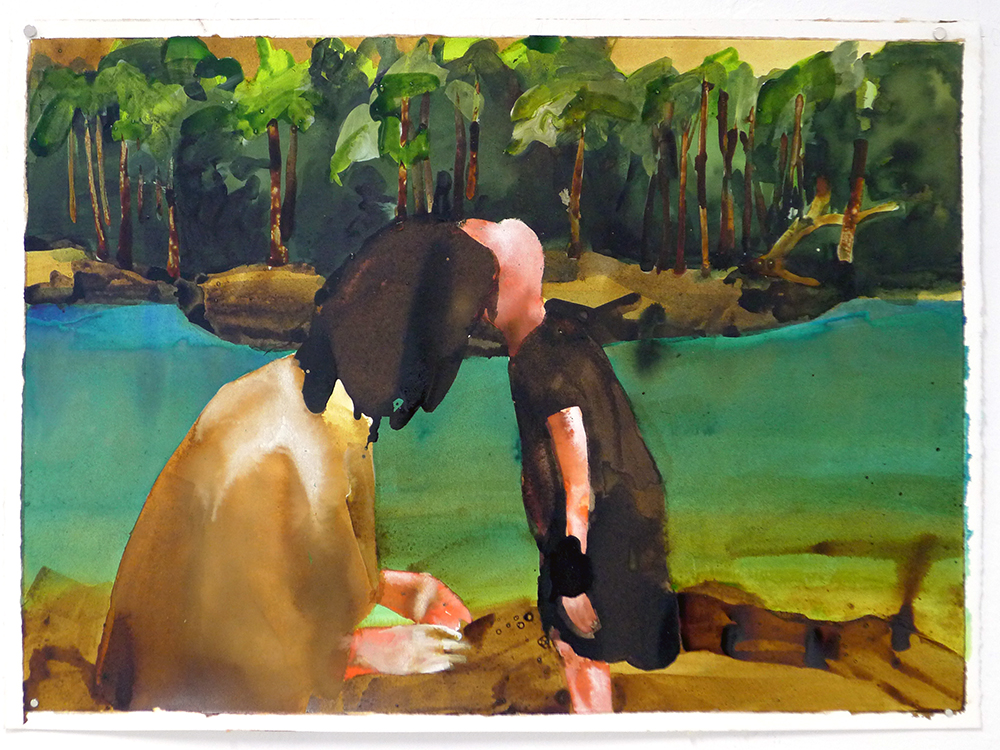
Loneliest Nonfunctional Boat
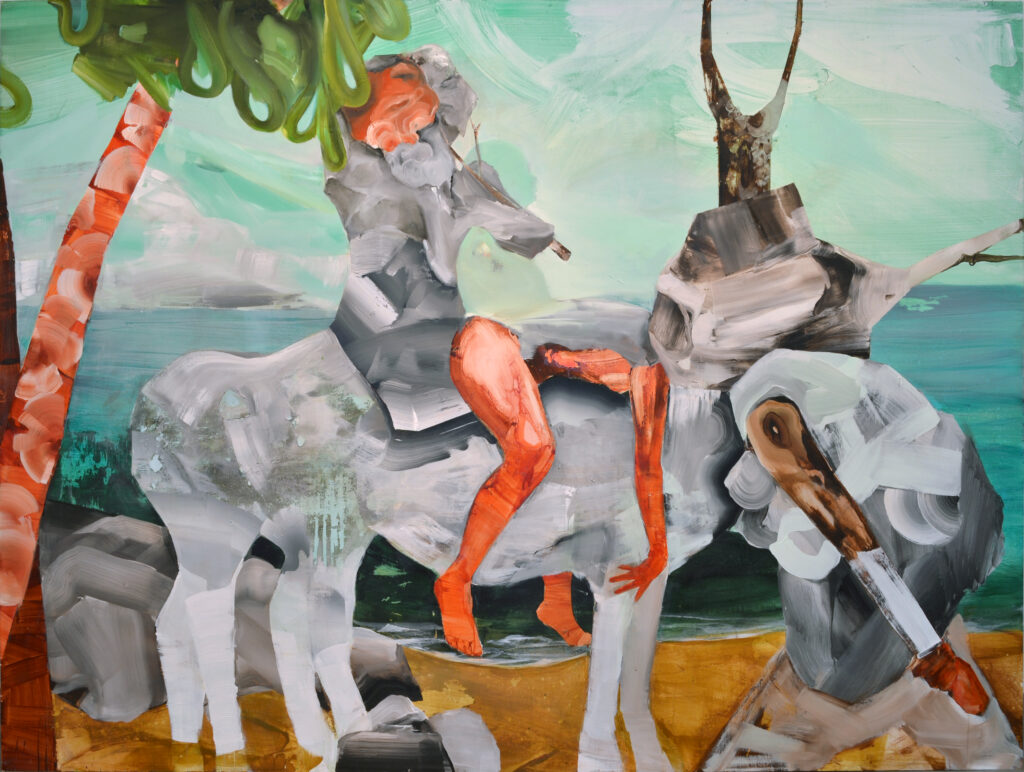
In Loneliest Nonfunctional Boat, the viewer is placed within a muted, gray atmosphere.
A solitary object floats in still water, reinforcing the quiet aftermath of collapse. This piece acts as a reminder that the world depicted throughout the exhibition is born from the destruction of our own.
Process & Narrative
Water is a recurring element in Glaessner’s work—both as a visual motif and as a physical force in her process.
“Water takes on a life of its own in the process of my creations,” she explains.
When asked about her process, Glaessner notes that everything begins with a story:
“No one knows my storytelling more than my sister. I used to keep her up all night with them when we were kids. These days, I keep myself up.”
Although she has attempted to write these stories down, she finds that doing so diminishes their power:
“It’s as though I’ve given them life on paper, and there’s no need to tell the same story twice. They lose their importance to be painted.”
Characters such as Celeste, Donkey Face, Serpentine, and Milk Maiden all originate from these internal narratives, each carrying its own personality and emotional weight.
Final Thoughts
Elizabeth Glaessner’s post-humanist surrealism is deeply original. Her work stands apart from much of today’s contemporary art—not because it seeks attention, but because it resists it.
There is a clear reverence for artistic tradition, yet her work never feels derivative. Where many artists lose themselves in imitation, Glaessner maintains a distinct and evolving voice.
While many pieces within the exhibition radiate optimism, they also carry an undercurrent of warning. The creatures and landscapes she presents reflect not only what could emerge after humanity—but what we continue to ignore in the present.
And perhaps that is the most unsettling element of all.
For more information on Elizabeth Glaessner’s work, please contact the P·P·O·W Gallery or visit: www.ppowgallery.com
All images are courtesy of the artist and P·P·O·W Gallery.
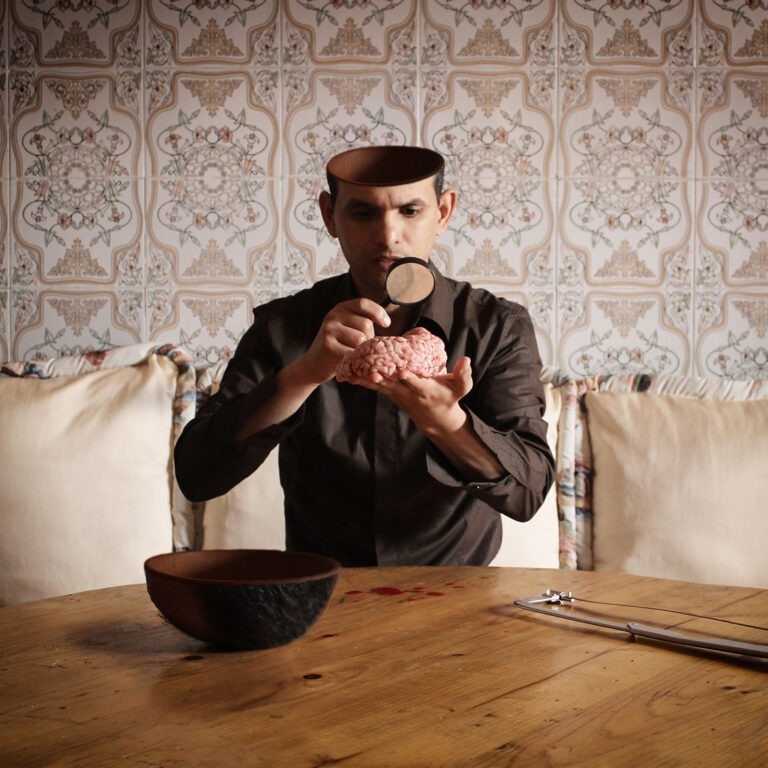
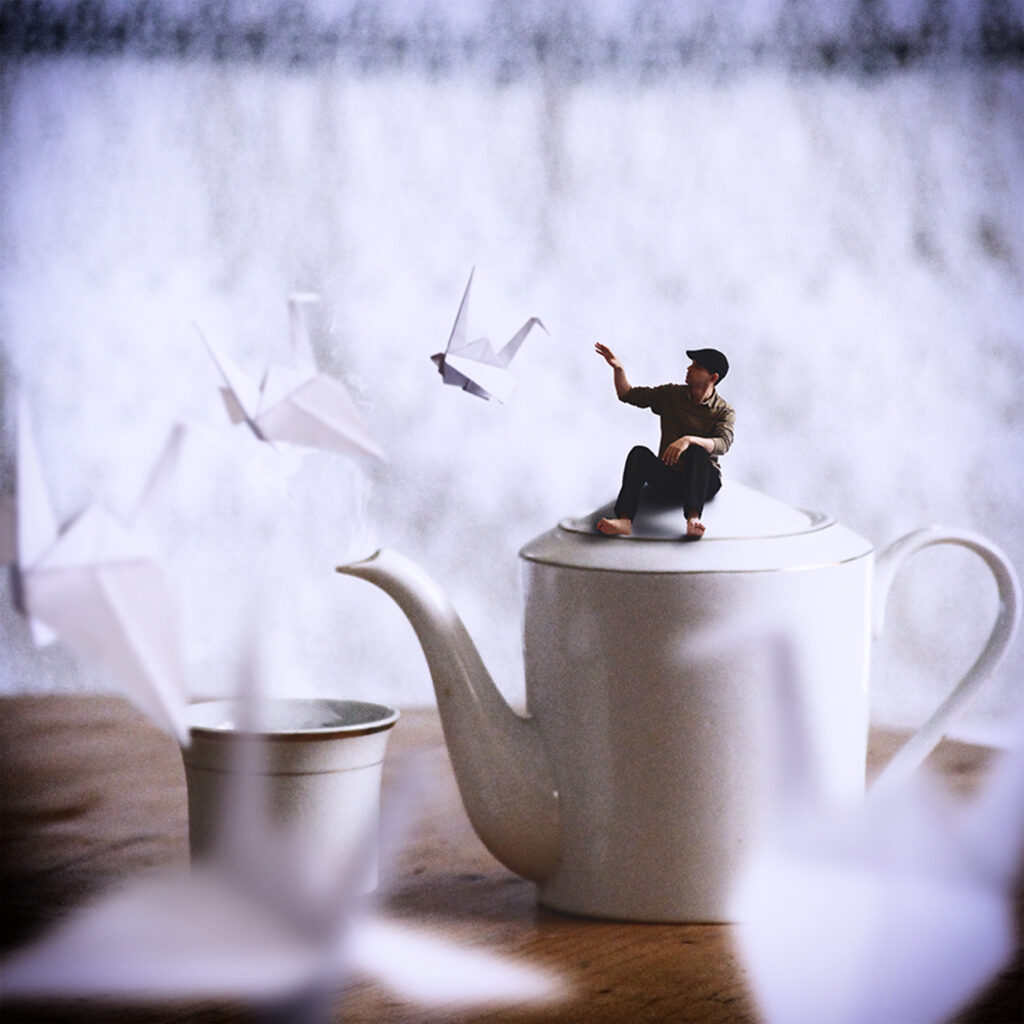
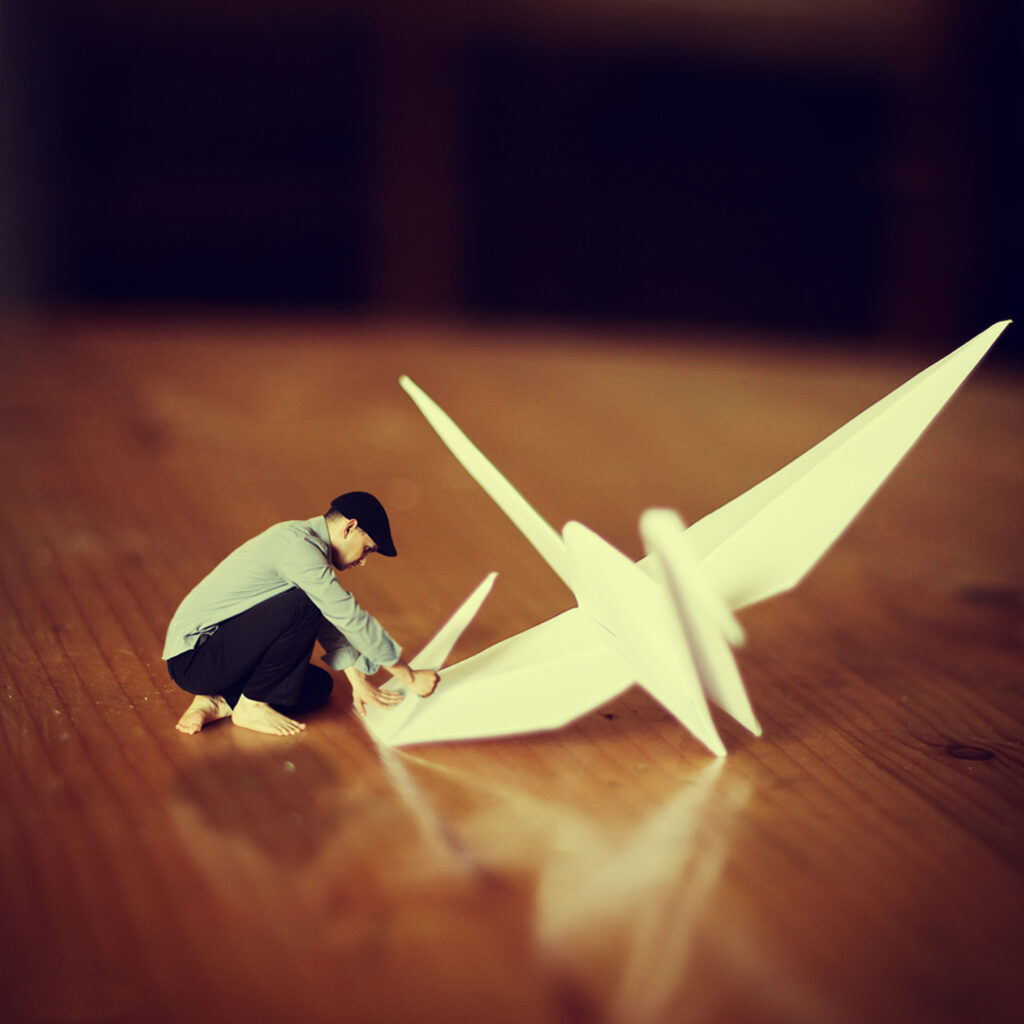
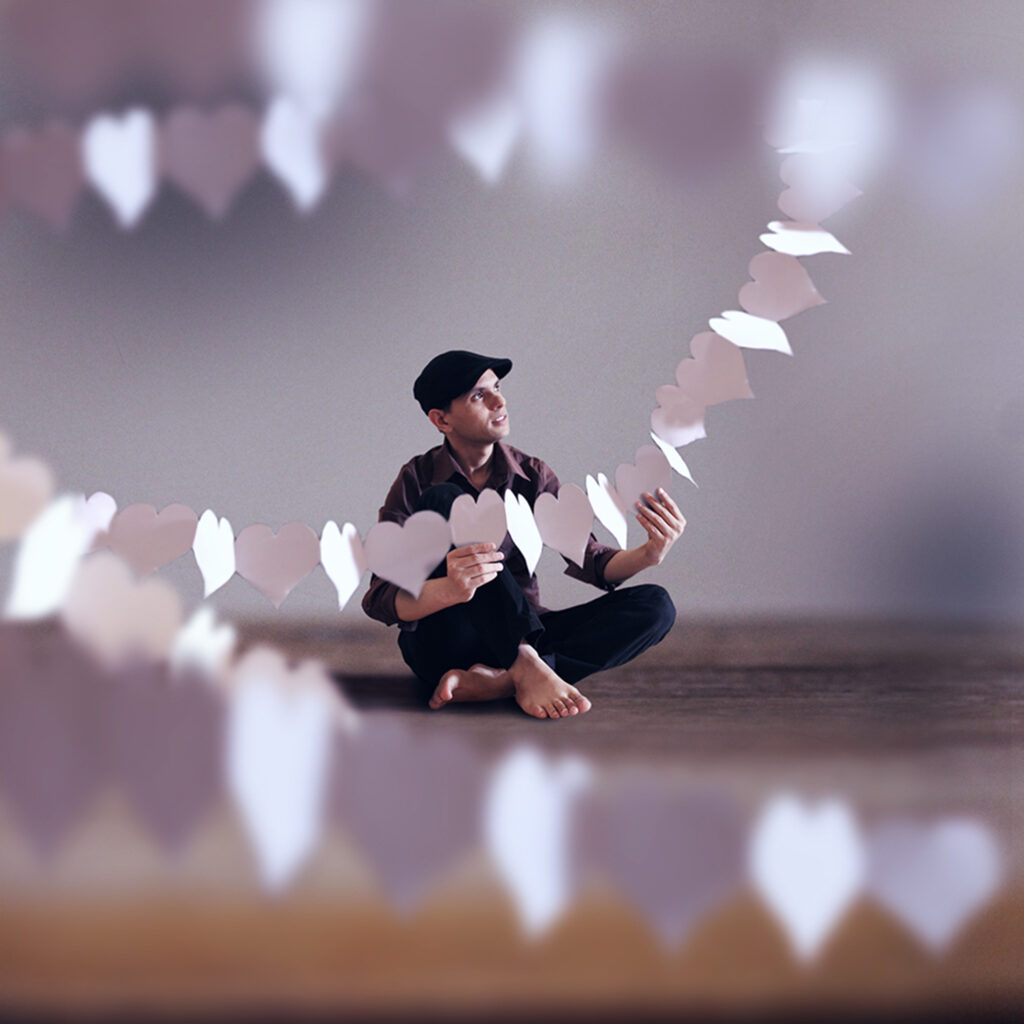
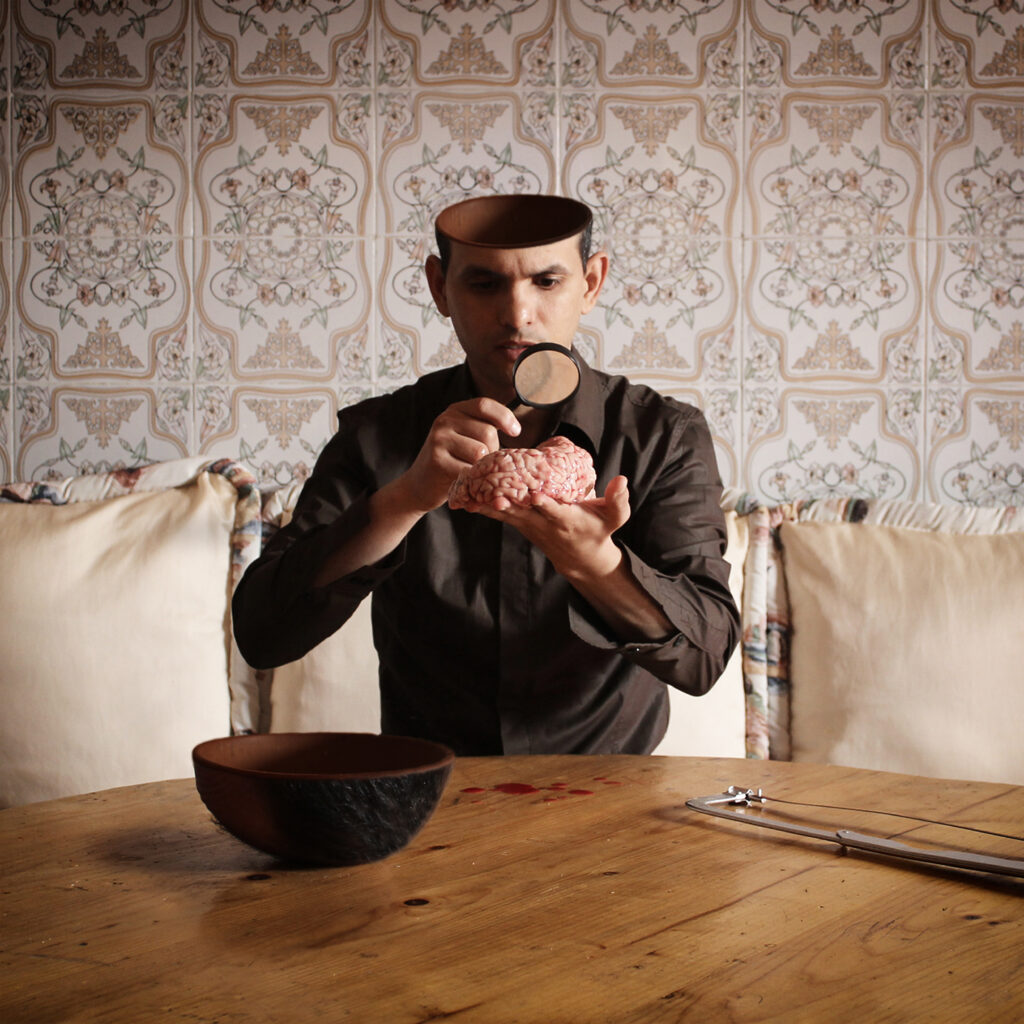
Conceptual photography is, first and foremost, about the concept of the photo. A conceptual photographer is trying to bring some message about to the viewer, be it a political advert or a social commentary or an emotional outcry. There is some level of abstraction, thus, in my works: the image is not an explicit example of the concept, but a general expression of the idea.
Conceptual photography makes healthy use of graphical symbols to represent ideas, movements, moods, anything and everything that the photographer might want to include in the message of their photograph.
For my works, there are a variety of ways a concept falls into place, most often it starts with a spark of inspiration and grows from there, whether it is a person, design, story that needs to be told, regardless, it all starts with a single point. From there it becomes simple problem solving.
I don’t spend very much time looking at what other people are doing. I like to stay aware and connected to what others are doing by following sites such as Flickr, but beyond that, I spend the rest of my time meeting people, creating, and really just living life. I think the best way to being inspired is not to just try to emulate others, but to find what inspires you in life and trying to capture and share it.
I use Photoshop CS4 and Lightroom 4. I use Lightroom to correct and change the color in my pictures. Then I go on to the most important Photoshop retouching. To learn how to master these tools, I spent hours in front of my computer to study the tutorials available on the Internet.
Biography: My name is Achraf Baznani i was born in Marrakech – Morocco. I started in photography when I was young, completely by chance. I got a EKTRA compact 250 for my birthday, which was intended to immortalize the good times. And finally, I was hooked. I then made several short films and documentaries, including “Onâ€, “The Forgotten†or “Immigrant†for which I received several national and international awards. Once again I am opting for photography, but this time the strange and surreal photography. I am self-taught and I have no formal education in this field. I published a photo book called Through My Lens.
Email: achraf@baznani.com Web site: www.baznani.com https://www.facebook.com/abPhotographe/photos_stream
Going to the studio is like going to war, but it’s a war you really want to win.
An Unquiet MindThe Empty Chair
Alexander Yulish is many things: an actor, a model, a native New Yorker, an Angeleno, and a student of everything life has to offer. But first and foremost, he is an artist. The son of a famed illustrator and sculptor, art has always been in his blood.
You can check out his oeuvre online here. Looking at the website, I was blown away by the immediacy, the raw energy of his palette and lines and I couldn’t wait to visit the gallery. In person, the paintings are even more visually stunning, at once playful and brutal, gripping, anarchic, intuitive; some are emotional to the point of being soul-crushing. I mean that in a good way- the kind of aesthetic soul-crushing that reminds you of something inside yourself, or teaches you something you didn’t know, the kind that taps into a primal part of the human spirit, the chthonic, sub-material that resides in the depths.
I sat down with Alexander in KM Fine Arts Gallery in Hollywood to hear about his new show˜Unquiet Mind and find out more about the intriguing and charming man behind all the semi-myths I read on the internet.
Deena : So, I stalked you online a bit before coming up with these questions. Your background seems really interesting, you grew up in New York, correct?
Alexi: Yes, I grew up in Manhattan. I grew up on MacDougal and 8th. And then I grew up in Chelsea.
D: I read that you grew up in the Chelsea Hotel, did you live there?
A: No, I grew up right next to the Chelsea but people always write that I lived there because it sounds more romantic! But yeah, I was around people like Patti Smith and that whole group on multiple occasions, so it was definitely exciting growing up there. This was before the neighborhood changed drastically; it was still Chelsea.
D: Your mother, Barbara Pearlman, is an artist as well? She hasn’t shown her work for almost 30 years. To what extent was your art influenced by her?
A: She was a famous illustrator for Vogue, and she travelled all over the world for her career. Then she got into fine art and that was her next progression. At one point her illustration career was skyrocketing and she just quit. She came back from a show in Germany that she had sold out and she just quit. She said this isn’t what I want to do right now, not in the sense of quitting art, but she only wanted to paint. She didn’t want to deal with the business part of art anymore, she wanted to make things really beautiful and pure. We had a studio in the back of our house so she would go and paint there; later she got into sculpture.
Recently she has come out of hiding. We’re going to have a show together, actually. We don’t know when or where, but a lot of people want us to have a show together and we are planning it, so that will be a great extension.
If you go to Pearlman Art you’ll get an idea of the environment I grew up in.
D: Was it during your formative years then, that she decided to just pursue painting, and do all this art for herself?
A: Yes, it was when I was around 6 years old.
D: So you grew up with the impression that art is for self-expression, it’s not something you do in a commercial sense, in order to sell things for profit? Art for art’s sake, if you will.
A: Exactly. As a kid I would spend hours literally just watching her paint. She taught me everything from drawing to color, but in a sense you can’t really teach someone to be an artist. I feel like it was in my blood. Part of it I think is genetic, it’s just in you. And the other part is putting in the work, so she taught me the craft.
D: Did she instruct you at all? Teach you color theory and give you advice?
A: To a degree. When we used to draw together what she would tell me is just commit to the first line, whatever it is. Put your heart into that first line. And then the second line, then the third line.
Really, there is no such thing as a painting, it’s just a bunch of lines. But at the end, if you’re lucky, you might get a painting and that’s great. Sometimes when I don’t commit to something I’ll throw it out, because I’ll realize that although I technically see a painting at the end, my heart isn’t in it. The paintings in this show, Unquiet Mind, I feel my heart is in it. The rest, that I didn’t put my heart in, they were hung in the garbage. So maybe some homeless person is using it for a blanket.
D: Were you exposed to a lot of art growing up that influenced you? When I look at your work I see a lot of de Kooning, maybe early Picasso..
A: You know, I get Bacon, de Kooning, Chagall, but when I look at myself I really don’t see any of that. I can understand the similarities in composition or in color combination and I take it as a compliment. But my favorite compliment I guess would be when you see an Alexi you just know it’s my work. It’snot self-conscious, though. People will go on and on about what they think inspires me. But I don’t even go to museums that much because I don’t want to be influenced. Things like memories influence me, like this conversation, maybe this will end up in one of my paintings.
D: Besides memories, what other types of things inspire you outside of the world of fine art?
A: Everything. Gravel. Trees. People. Cities. I don’t think there’s anything that at the end of the day doesn’t inspire me. You have all these experiences every day and it just starts to seep into your bones. If you take a shower some of it wipes off but most of it’s stuck in you.
It’s really hard for me to talk about my paintings because essentially they’re just conversations and the conversation shifts.
D: Speaking of being inspired by cities and the environment you’re in, you moved from New York City to Los Angeles. Did that change in atmosphere affect your creative output in any significant way?
A: I moved here because I had already done New York. At the age of 25 I thought, Okay, I grew up here, I was going out when I was 13 years old. So you experience those things, then all of the sudden you want to experience something new. And I did. And I hated it here for the first 2 years, but then I stopped comparing. Once you stop comparing you can actually appreciate LA for what it is. I made peace with it and I fell madly in love with this city.
Plus, I have room to work here! In New York it would be almost impossible to have that much studio space.
D: So you can work on a larger scale than you would in Manhattan.
A: This show is a little bigger than the last show; I just feel like I had a lot to say and it came out. Emperor of New York was similar but different. They all have the same conversations but they’re different.
I don’t even know how to name my paintings. I have friends name them sometimes, just because it’s like the experience we’re having here and talking. Imagine you had to name this conversation…it would be the strangest thing, what would we call this?
D: It would be hard because there are so many subjects, there’s just a lot of content there and so many things going on.
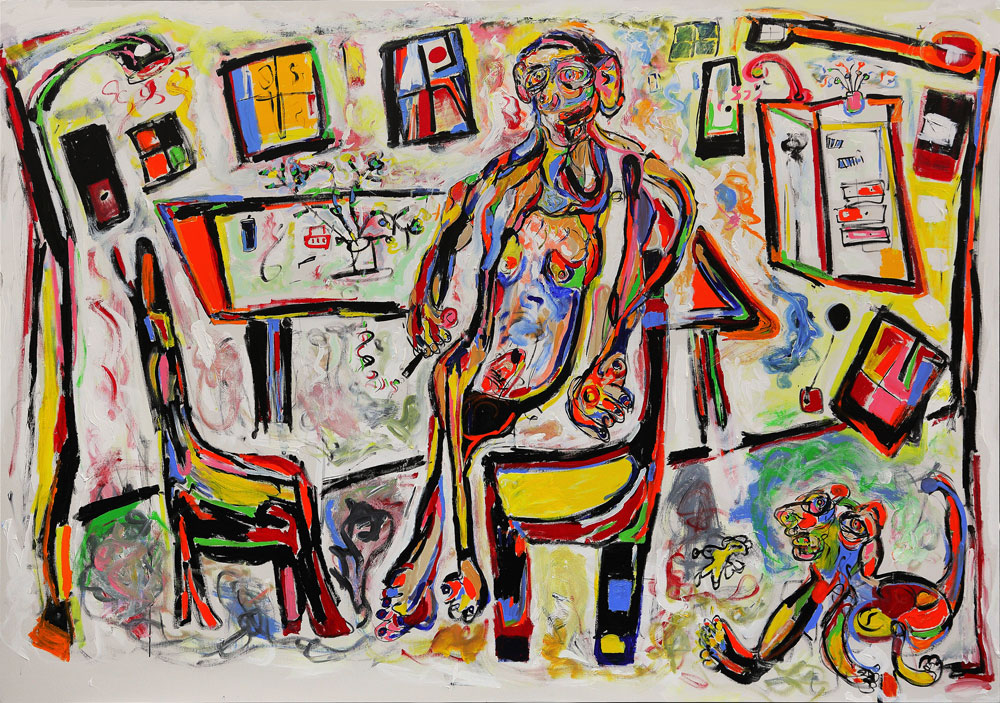
A: Yeah, so that’s like when I finish a painting, how do I possibly name it? Sometimes some of them can be more figurative, like this one I called The Empty Chair”because to start there actually was an empty chair, although later I switched it, but that one was a little easier.
It’s messed up because you can have a painting with a really cool name that isn’t that good and vice versa. Or the name can influence you; for instance, a painting might be called “Sunrise on the Moon” or something, but if you named it instead “Battlefield” that’s what people would see and take away from the painting when they looked at it. Subconsciously it’s amazing what naming does for a piece. I don’t want to name anything “Untitled #5 ” or “Series 2,”or “Man Walking Down Stairs Holding a Staple Gun” I just don’t do that.
 D: Have you ever tried to work backwards, come up with a name first and then paint based on that? Like a writing prompt.
A: No, I haven’t done that! It’s a cool concept though. Sometimes I give myself scenarios, such as, Today, I’m going to do a black and white piece. Giving yourself restraints like that can be fun.
Going to the studio is like going to war, but it’s a war you really want to win. You risk everything knowing that you can lose, even at the last moment. Sometimes I get to the end and I’ll be like okay I got it, this is almost done and then all of the sudden at the last minute, you end up doing something at the bottom of the canvas that just doesn’t work.
Everything’s a puzzle. If I do this blue line at the bottom it has to balance with something else. It’s like ping pong. So you can lose a painting at any moment. And that’s what I love at the same time, it’s unpredictable. And that unpredictability is what makes me want to paint. If it isn’t a bit unpredictable or dangerous I don’t get interested. Some people think because I use so many colors there’s a really happy energy, look a little deeper. It’s a dance. A lot of these paintings change every time I see them.
D: This kind of malleability and flux, is that something you are hoping people take away from your art?
A: That’s what I would like people to experience, to see something different every time.
At the end of the day, you have to paint for yourself and you just hope it translates. I feel lucky people are buying my stuff and getting inspired and the show is doing well, but at the same time, if it didn’t, I still would have to paint. Even though there’s nothing really romantic about doing something that people don’t appreciate.
D: Art is inherently subjective.
A: Yes, there are certain things people like. I saw someone just get pounded in their stomach when they saw this particular painting (Closer) and then the next person walked by without barely glancing at it. You’ll overhear people; sometimes they get excited and sometimes they’re saying they don’t really like it.
But you can’t let that affect you personally, the business part of it. The business part is so important and that’s the scary part because I just love painting and want that to be separate. I think the idea of identity is just the weirdest thing, having to say “Im a writer or I’m a painter. What does that even mean? It’s so limiting.
D: You want to do what you love but you also want to make enough money from it that you can continue to do what you want so you don’t t spend your day at a soul-sucking job that leaves you with no free time to pursue your passions.
A: Oh god, yeah. I’ve done the weirdest jobs.
D: What’s the weirdest job you’ve had?
A: I’ve been a food delivery man in New York City, that was a really strange one. I had to ride a bicycle and bring food from this place called Live Bait and I would go to the weirdest homes and people would invite me up. I would literally just sit there and talk to people while their food got cold. Or sometimes I would crash the bike, spill everything and I’d have to reassemble their food.
When I first came to LA I worked for this reality TV show called “Change of Heart” and the premise was I had to find people and then these couples go on a date with the other people and then have to decide if they still want to be with their significant other. So I literally would go up to people and ask if they wanted to make $500 to be on this show but technically I would break couples up. People would call me afterwards and yell at me, saying Why did you put me on this show? You made me look like an idiot! So that was one of the strangest, really, really odd.
But yeah, I’ve done everything. When I got out of school I started modeling and I went to Europe and I didn’t like it at all. I lived in Milan for a while and it was so strange but I would do it all again, I just love experiences. And I like watching people. I get really curious about people. I need people. Just as much as I need to be alone. If you’re a painter you spend a tremendous amount of time alone, it’s very introverted. But at the same time when you’re alone there’s only so much you can learn. It’s so good to actually talk to someone.
D: You get to bounce ideas off of people?
A: Yeah, and get excited! There’s nothing too romantic about being tormented in your home. Wearing sunglasses and telling no one to come see you or look in your eyes. Having your assistant say “Only speak to Alexander Yulish when spoken to,” or something like that. I mean we’re all eccentric in our way but there has to be a balance.
D: Speaking of the artistic process, I read you have a place in Mexico? Is that where you go now to paint?
A: I’m starting to. My mom and I are moving to San Miguel, and we found the perfect place but it ended up getting bought literally right before we made the offer. It was our dream home, with these huge studios. We ended up finding a place further away.
D: San Miguel, that whole area is a big expat artist community.
A: It is! But it’s weird, I don’t like hanging out with other artists that much. I wish it was the time of Picasso and Modigliani, and that whole crew back in the 20’s; they all bounced ideas of one another and they all critiqued and it’s just not like that anymore. Everyone always says they want to create that kind of a space again, they want to re-create Warhol’s factory, but no one’s ever going to recreate that.
D: Growing up in NYC during that time must have been interesting. Warhol was still alive then. And you got to experience the height of graffiti before they really cracked down and stopped running the trains with tags on them. Did you ever do street art?
A: Oh yeah, we would tag any place we could.
D: What’s the coolest place you tagged?
A: On a church. Just kidding! That would’ve been really bad. We would literally just dare each other, we would tag the sides of police stations, I’ve gotten chased. We used to get in bad fights, cross out the wrong person and they’d know you! It was a little more innocent, people didn’t just shoot you, I mean down town but that wasn’t my personal form of expression, there were people who were complete masters, geniuses. Street art is a very strange thing right now. It was the height and now there’s a group of street artists who will go down as unbelievable.
Everyone likes street art right now but not everyone’ s a street artist. There’s a difference. Some of them are going to be in permanent collections of the biggest museums in the world and will be appreciated. Someone will do a throw up and it’s not nearly as profound but sometimes you just see something and you can’t even express it, it’s just insane. Sorry, sometimes I have trouble with words. Saying something is insane doesn’t really describe it.
D: I know what you mean, I say awesome all the time when I really like something, and I don’t know why those words even comes out my mouth because things are always so much more nuanced than that and we have this whole rich vocabulary at our disposal.
A: Exactly, because at the same time a color will express it, like Blue or Ultramarine Blue, that’s like how I feel and then other times, that’s not how I feel. I have to create a whole new blue. But then you realize you can never create a blue, everything’s been invented.
D: Well, Yves Klein made his own blue and he patented it.
A: Oh, you’re right, that was a bad example with the blue, now you’re like ‘You’re an idiot, Alexi you need to do your art history!’ Ha, I hate art school.
D: You mean when you went to college?
A: Yeah, I just hated it. My mom was my real art school. And that was essentially years and years just watching her and experiencing that. But in school I hated my art teacher. I remember once I had to render a chair and when I was done I decided to elongate everything because that’s how I felt. But my professor was upset because it wasn’t what he instructed us to do. It was a constant battle.
At the end I remember I said to him I’m an artist and he said, ‘That’ a pretty bold statement. People spend their whole lives before they can call themselves an artist’. And I looked at him and I said, ‘Well, that’s their fucking problem.’ And he just looked at me, and that was that. It was bad so I quit. It was just such an awful experience.
D: Because it was limiting? You didn’t have full freedom of expression?
A: Basically. I could render something if I wanted to, exactly life-like. But at the same time, I remember drawing with my mom and she taught me to just extend a line until it emotionally stops being relevant to you. When the emotion stops the line stops, so a chair or an arm may go out all the way across the canvas and then all of the sudden it ends.
But there has to be a dialogue, you can’t just take it all the way out for no reason. So you may do that but other things have to balance.
In a sense, there are no rules. You create your own rules. There’s an alphabet, just like if you were to write a book, you would have to use an alphabet. Here, the alphabet is colors. Sometime the colors may not be enough so you grab a branch off the ground and stick it through the canvas. That may not be enough, so you start using everything around you. Some people use cement bricks, and they build a brick wall in the middle of a gallery. That works emotionally for some people. For me it doesn’t. But everyone has their own form of expression.
D: Speaking of forms of expression, you’re an actor as well. You were in a David Lynch movie?
A: Yeah I was, it was such an interesting experience. I wanted to meet him, so I did and it was at the end of his movie “Inland Empire” and I remember getting a phone call the next day asking if I wanted to be in the film. They just told me to show up on set. It was towards the end of filming and it was a fun experience. I love acting but it’s not something I share that much. Sometimes people want to know the story; yes, I did acting and I did a lot of things, then they’re like ‘Oh, you came to painting later in life,’ but, no, I didn’t. I’ve been painting my whole life. I just decided to focus on it, and I got really fortunate. It’s funny, acting doesn’t do it for me the way painting does.
D: Because you’re following someone else’s script?
A: Yeah, I don’t like people directing me how to do things. The only thing I have to worry about now is the guy who created these colors and put them in a tube.
D: Well, hopefully that guy knows what he’s doing! You’ve mainly done acrylics so far?
A: Yeah acrylics have gotten just unbelievable, they’re very different from oil in a sense but at the same time it’s very immediate, and that’s what I love about it, the immediacy of it.
D: Do you always use a really bold palate?
A: Sometimes. Sometimes I won’t use them, and I’ll only use a blue. Or a black. I don’t paint for the sake of using a lot of colors. I use colors because that’s how I express what’s going on. But everything changes. I’m curious to see where I go in the next 3 years, 4 years. Every show is different not for the sake of being different but because the vocabulary, the language changes.
D: I read something about someone seeing your cellphone background and that’s how you got discovered?
A: I was at the Chateau and I had just gotten my first show here but I was sitting and this guy who is a friend of a friend sitting at our table saw my phone background and he asked who did the painting. It turns out he collects art, so to make a long story short, so he bought a bunch of my stuff and told the Annenberg family about me, then they contacted Leila Heller at her gallery in NYC. There was a show called “The Young Collectors Exhibition,” and that went really well so I started having bigger collectors. I was just fortunate but I worked very hard. Really there’s no correlation between working hard and doing well on the business side, a lot of that’s just circumstance. You just have to be in the right place at the right time. And the work has to be good.
D: Your paintings are abstract, but they do have recognizable things in them, such as a chair, or a vase, or a body. When you make the first line, that line you commit to, do you have any foresight that eventually, it’s going to become a human, or a lamp, or whatever?
A: Not really. I commit to a shape whatever it is. Then I’ll start to disintegrate the shape. Like this one painting, the shoulders were out to here. And it felt right, but then you realize it’s not balanced. At least for me. Sometimes it works when you have huge proportions. This one all of the sudden started getting very compact and very it felt like everything started to get squeezed in.
D: So you painted over the shoulders?
A: Yeah and it was just constant, you know a chair, this chair turned out to be a long couch. And then it felt…it could be anything, it was actually a drink when I finished it. But sometimes it’s not that figurative. There was a desk I think, which I completely erased. It just constantly changes.
This one was called “Family” and now it’s “Alone Together”like how you can be surrounded by people and be very much alone. It’s very much about being in the city. I had just gotten back from NYC and this kind of came out from it.
D: I’m really glad I can ask you these questions in person and we can point to the individual and paintings and talk about them. Because I had this whole list of questions, but it changes when I meet you, and when we are actually looking at the paintings as a point of reference. This sounds odd to say as someone who writes about art for a living, but what do we talk about when we talk about art?
There’s a Gerhard Richter documentary on Netflix and at some point, I’m paraphrasing here, but he says something like “To talk about painting is not only ridiculous but beside the point.” Painting is another form of thinking. Words are only capable of expressing words and painting has nothing to do with that. And I just thought that was so beautiful.
A: Wow, yeah! You completely get it. Painting is another form of thinking. I completely agree with that, I didn’t say it as well as that, I’m not good at speaking and that’s why I paint. It’s difficult and pointless too because our conversations are completely different. It’s also that, to me, painting is another form of thinking that can be very ethereal. I think it’s another form of expression. When words aren’t enough I paint.
When I was little the New York City Ballet was always a thing because my mom was very much into that scene. I would meet all these set designers, all the greats. So you’re around all of that and it just inspires you. In everything, textures, I’m very visceral.
The texture of gravel, you mentioned that earlier.
I changed my mind about gravel. It’s concrete, I go to New York and I just go touch the concrete, I touch everything.
Well, there you have it. Alexi Yulish is a truly incredible individual and a talented visionary; you should check out his work in person if at all possible. He may be touching concrete in a city near you! If not check out his gallery online. alexanderyulishart.com/
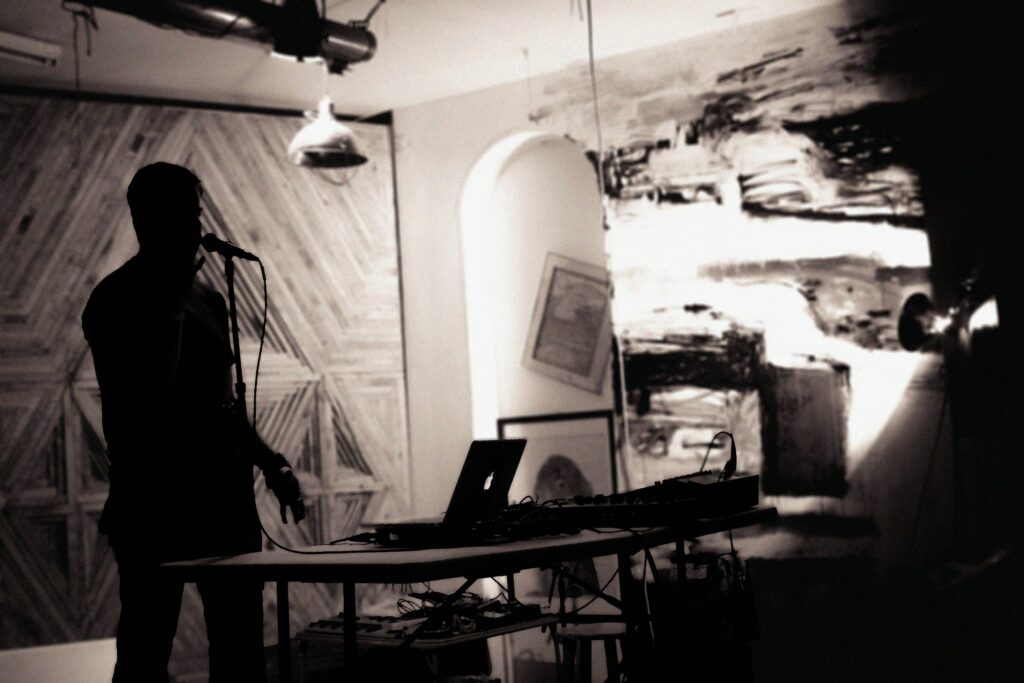
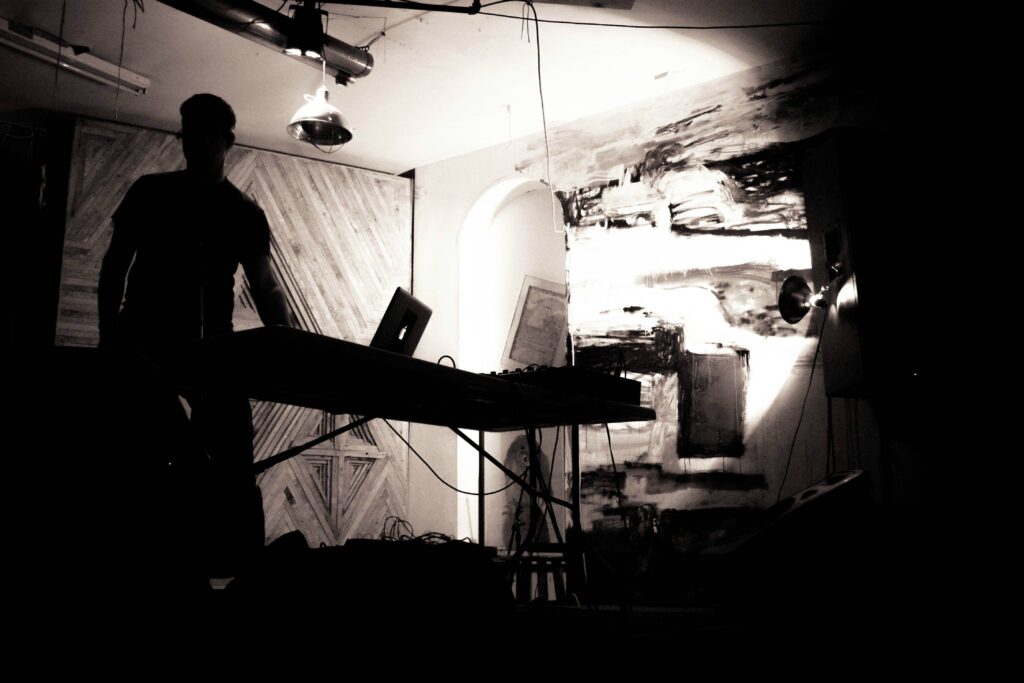
I went to the first night of the fourth installment of the modestly legendary Ende Tymes Festival, a weekend-long celebration of experimental music, video, and art. It was situated at The Silent Barn in Brooklyn, NY and on Sunday at Outpost Artists Resources in Ridgewood. It’s an entirely independently funded festival of extremely noncommercial music mostly harsh noise started by musician and organizer Bob Bellerue. I went on Thursday night, May 8th, to see what the noise (so to speak) was all about.
The concert is notorious for being what Bob has described as the one noise concert of the year for a lot of artists and musicians in the Brooklyn area. Its substantial line up served as a powerful draw of likeminded artists around the New York area. Performers had a focus on textures, performance, innovation, and the extreme ends of the sound spectrum. A wide sprawl of different ethos drives the artists on display, but experimentation is their shared connection.
As an event organizer, Bob Bellerue is a modest, well-spoken man, kind and easygoing. Organizing the event himself, he skews away from commercial sponsors, handpicking the acts based on who he personally enjoys. Low budget and ramshackle, Ende Tymes operates entirely on handshakes, informal agreements and whatever free promotion the internet can offer. It’s an unspoken majesty of the experimental arts world that I will proudly defend: no one is in it for the money. This is true expression, take it or leave it.
A short walk from the Myrtle/Broadway J train stop brought me to The Silent Barn. Performances had begun on time, which was a little unexpected. Bob is strict and regimented in his scheduling; like some others I know in the same position, he’s dealt with enough noise code violations to understand the importance of the strict itinerary. And everyone helps each other. A percent of the door goes to the performers, who are vast and from several places in the world. An average performance length of about 15 minutes promises speed in delivering weird or transformative experiences.
Unaccustomed to bands who keep their schedules so strict, I miss Chris Pitsiokos’ performance with Philip White as well as Limax Maximus. Their performances, already uploaded online to UnARTigNYC (unartignyc.com) by the time I wrote this story, are excellently diverse and colorful.
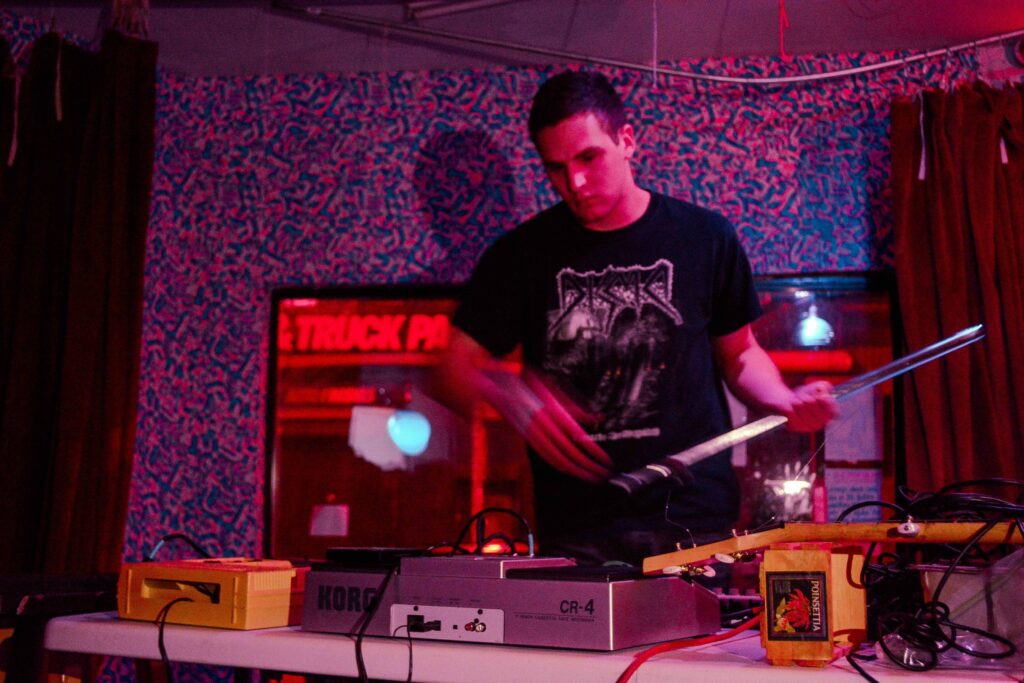
I entered to the sounds of Lazurite, one electronic musician whose manipulation of live samples created an unusually immediate reaction. She was weaponizing sculptures installed in the Barn’s main stage, building a squeaking groan into a disarming, unexpectedly ebullient swell of buzzing drones and a kind of distant, glimmering twinkle of something that at full volume would be quite terrifying, but in the distance, has an odd allure to it. It strikes me as a “gem†sound, for its crystalline, elusive beauty, and how it holds the air in stasis.
In the midst of the audience were most of the performers. They are all friends to some degree, and usually associate on Facebook in different music groups, where the proliferation of event sharing ensures a loyal attendance. I met up with Rat Bastard briefly, who I had previously seen in Gainesville when he was promoting the International Noise Conference, his noise festival.
I’ve done INC [at The Silent Barn] before. There’s too many f***ing rules now, he says when I tell him I’m excited for the next performance. Now you can’t take a beer, can’t take a s*** with a beer, he laments.
As a member of the Laundry Room Squelchers, Rat is privy to the kind of psuedo-celebrity status of other noise artists with long and influential careers. His show is last, and he’s a major crowd draw.
Following Lazurite was one of the most spectacular performances of the night, Phill Niblock. A lasting force in avant garde music, minimalism, and experimental composition, Niblock has had influences on artists such as David First, Sonic Youth and Glenn Branca. Armed with nothing but a computer and a beer, he drew layers upon layers of simple waves into a heart stopping superdrone.
It could only be called such, a superdrone; past the dirges and chants, coursing through the legacies of the Scottish bagpipe and the esoteric artifice of the snake charmer, the raga and the sitar building more furiously, growing metallic and mean and brighter than organic instruments but still perfectly seated in the middle of your ears, it was a breathtaking performance, unmatched. At 19 minutes, it felt far longer and yet I didn’t mind it one bit. I sat down and got some thinking done. At one point I may have tried to meditate. Niblock sat patiently at his computer sipping his beer, then folding his hands together.
Worth followed, an artist who utilized a string of effects pedals and a device called a no-input mixer, which is an audio mixer that creates sound out of pure feedback. Existential implications aside it burst forth in piercing tones in harsh timbres and occasionally thumped a deep heartbeat or a cat’s purr or a motorcycle in idle. At the end of the performance it was wailing and screaming, as it is wo’nt to do.
I took a break and went out for some fresh air in the side entrance and stone garden that wraps along the side of the Silent Barn. Lazurite and their friends were relaxing, and I knew one or two people there to kill time with. The experimental community is a fairly close knit one but everyone is welcoming and friendly. I had a drink outside and surveyed the sculptures and art. As I stood up to return, I heard the sound of a broken pipe. It may have been gushing water into a metal bin.
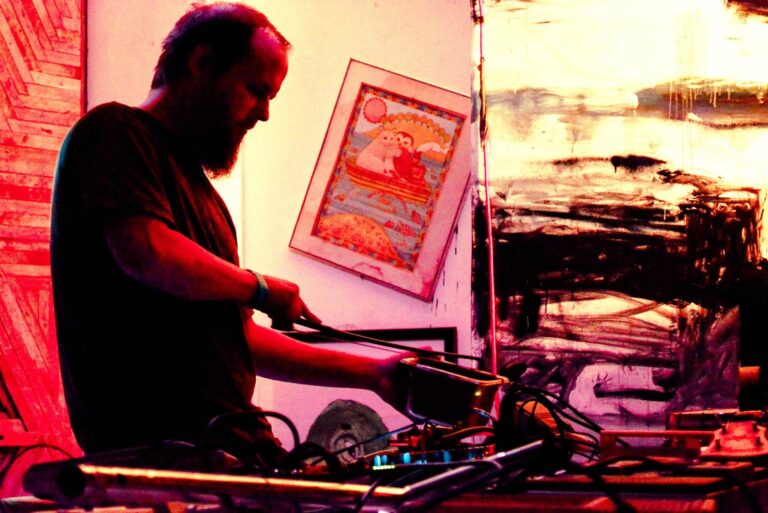
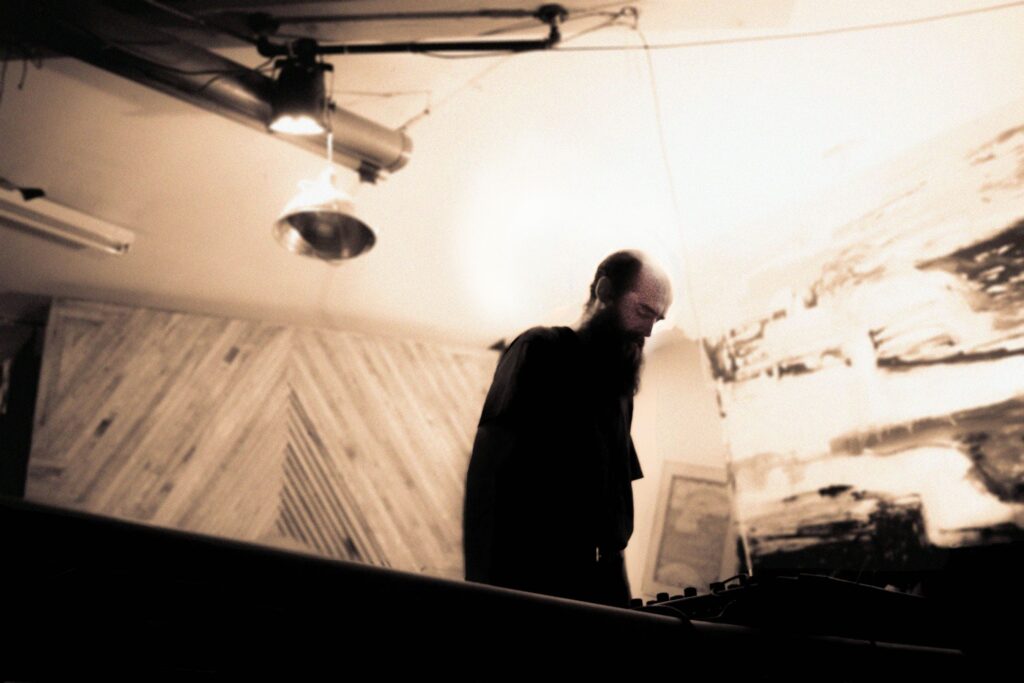
Past the flimsy threshold between the outside world and what is now a Taskmaster performance, I heard the sound of two trains colliding. It just kept going and going. Vicious and metal and loud, the A and C trains crashing together in parallel from 125th to about 14th. No wait, now it sounds like children clashing pans. No, it’s two hundred gamelan players with no rhythm playing their hearts out. Then everything gets blurry and sounds like a nightmare. It’s about half over at this point. Taskmaster grabs a wire which (I guess) makes noise happen, and locks his arms spread out, Diane Arbus hand grenade style. He has an impressive beard and a monastic disposition.
Next on the stage was one Jean Sabastien Truchy, who I am unfamiliar with. His music consists of stark, binary drone up note, down note, beat, rest, etc. and a disturbing stage presence. In a truly unnerving cadence, Truchy contorts his hands and moans like a tortured prisoner. The industrial pulses behind him grow stranger and collapse under electronic processing. He’s also rocking the monastic chic look, but of a monk who’s rooting for the other team. Then he just starts screaming like a regular demon. I’m thoroughly terrified and impressed. Once in a while a burst of noise subsumes another and it’s almost briefly kind of catchy. It’s very pretty at the end, with layers of voices and wind gusts.
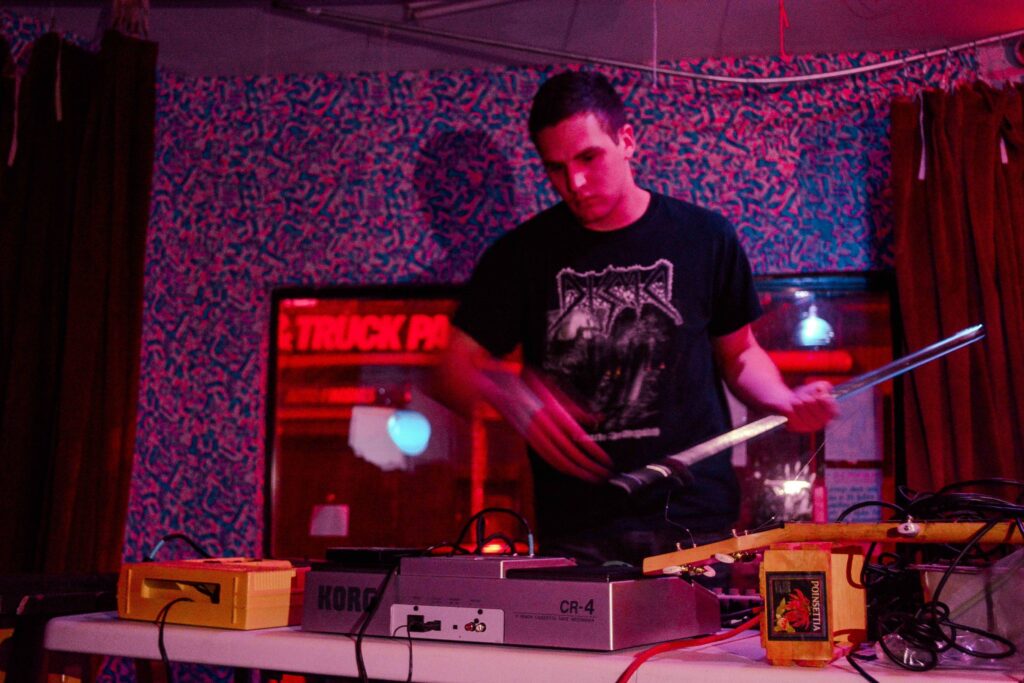
Truchy gives way to Shredded Nerve. He has on black boots and shorts and a t-shirt for the band Disma. Sometimes when people use loop pedals or looping equipment of some kind they like to use interesting sound sources and in Shredded Nerve’s case he banged on metal grates and used a metal billy club with a microphone attached to it. It was sort of catchy, or it was infectiously looped until satiation set in and I could hum along to it. I’m pretty sure at some point the sound of someone urinating was sampled, which has a long list of precedents.
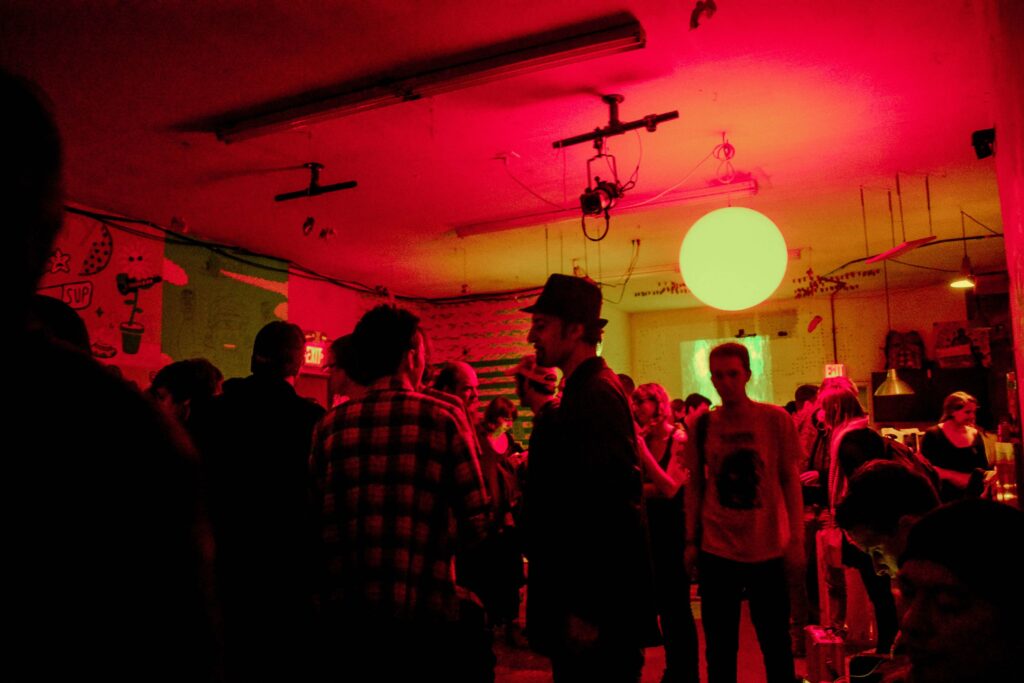
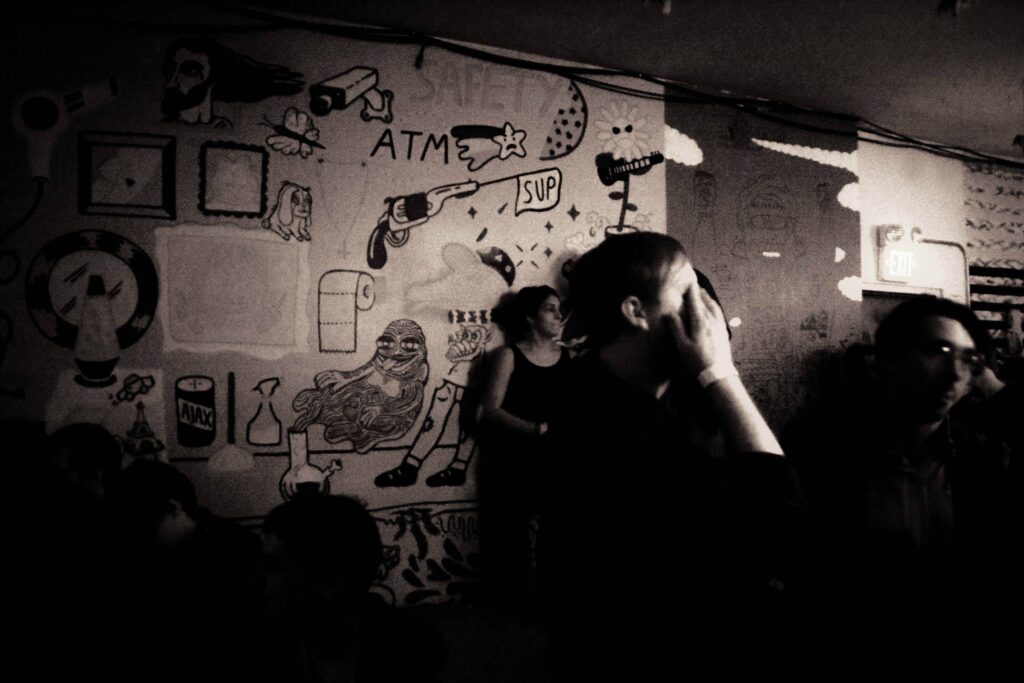
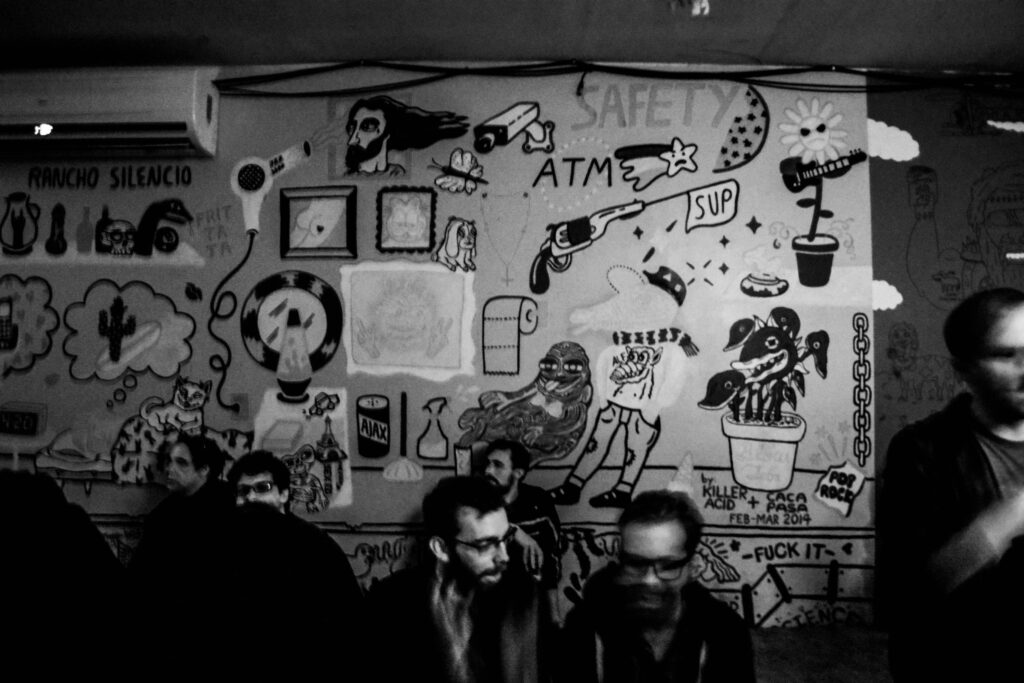
I was eager to try out the camera, which I had borrowed. The stage proved difficult to photograph due to low lighting, so I wandered around the venue. The Silent Barn was cluttered with trinkets, walls were covered in graffiti, and the side entrance contained not only a ticket booth but also a barbershop, where customers are encouraged to pay what they think their haircut is worth.
I took a few shots of the interior and some of the art. Walking around I saw art peppered along the walls and rooms full of people talking to one another. Each of the musicians who had played earlier seemed to have a cabal of people who knew them. There were about three degrees of separation between everyone in the room. I took a picture of Bob as he opened a back door, perhaps to retrieve some more cables. Everyone needed lots of cables at shows like this.
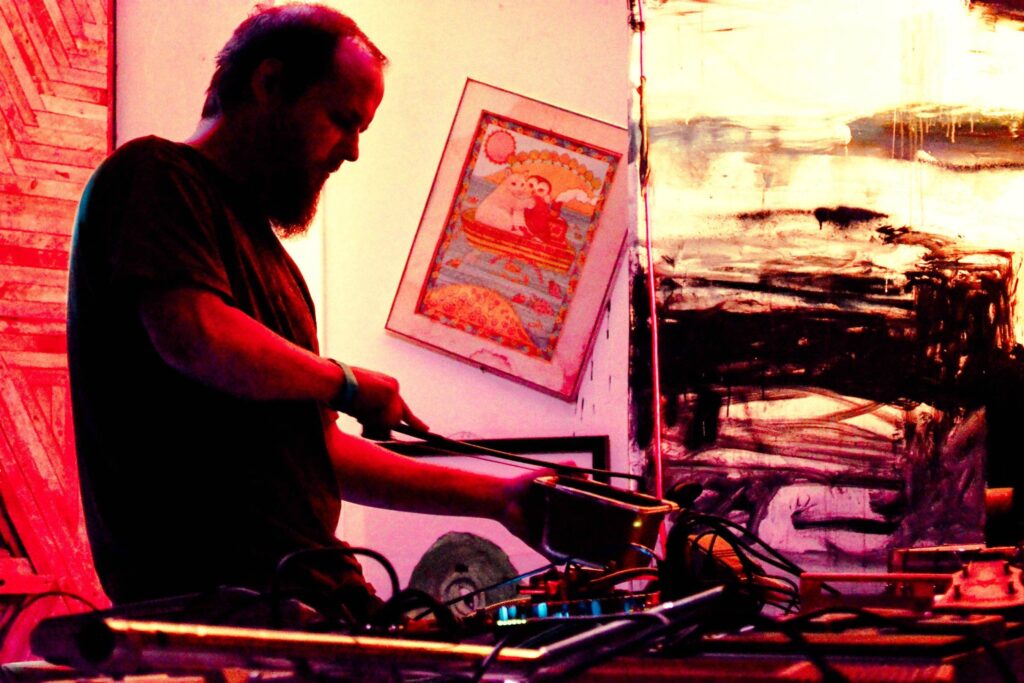
Developer was the most actively diverse sound painter of the night, serving a buffet of interesting and far-reaching timbres interspersed with small, neat experiments like a microphone on a door hinge, and it squeaks! When I closed my eyes it was impossible to track. It reminded me of being stressed in the morning, when my fatigued mind can’t form a complete thought. Then he bowed what looked like a drying bin for utensils, and at some points along the bow it sounded like an electric guitar. Other noises turned up in pitch and squeaked humanly, and then some genuine bells, musical bells, played before more noise happened.
Slasher Risk were a duo who lit sage to cleanse the venue before playing some post-rocky guitar melodies for a few minutes. It was very moody and kind of nostalgic and sweet. Then someone turned a knob and the melodies became a guitar tornado. Slasher Risk’s attention to detail in the evocation of irreverent 90s alt-rockers was too spot on for the crowd to appreciate. They riffed and posed and twisted their hips lackadaisically while snarls of blown-out bombast whirled about the room. It was very dark and I couldn’t take any good pictures of them and at one point a half dozen attendees tried to start a mosh pit.
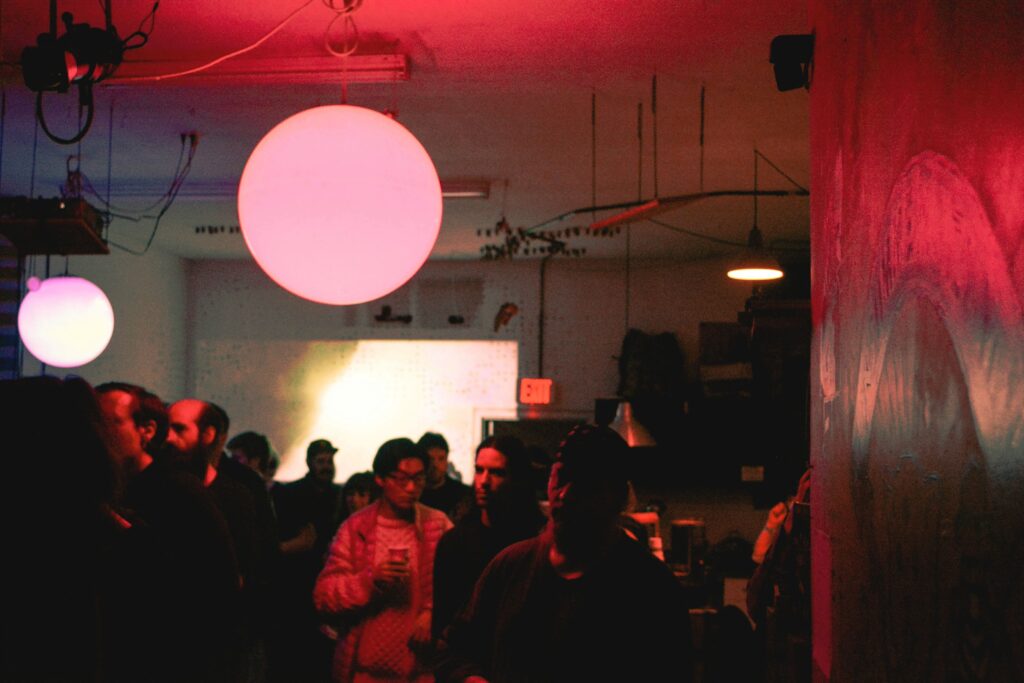
Again I was reminded of simple binaries. Silence and noise. Total harmony, then the beatific, cathartic buzz of the atonal. Suspended in the air of the room were two glowing orbs cycling through colors. They glowed along with the music, getting brighter or darker as the volume rose or lowered in the room. But tonight everything was so loud you’d never know. They were fully beaming, in soothing pastels and loud neons.
What began as work/death’s performance turned into an opportunity for me to clear my head a bit. I took off around the street corner for some food and to check my ears to know what kind of damage I’d accrued. I felt guilty for skipping out on the show and subconsciously ill from the absence of sounds. It was as if a great vacuum opened up in my head, far more punishing than anything emanating from the little venue behind me.
Normally at this hour I would have been hearing an arresting, echoing herd of piano chords doused in processing by work/death’s mindful and brilliant Scott Reber; I had to rectify that problem. I managed to make it back after around 10 minutes right as something kind of transcendentally beautiful collapsed into something darkly creepy. It kind of toed that line for a while before fading out.
Blessed Thistle was Bob Bellerue himself, a standard (for this crowd) performance that was nevertheless thoroughly satisfying. He screamed, whipped white hot sonics up and down, pressed buttons that made things growl or hiss or buzz, and at one point shook his gear around violently, knocking some of it to the ground. Bob was the Platonic Noise Artist, his highs perfectly highs, lows just right, and just enough interaction and scalding fury to come alive, particularly when he yelled and shook the flimsy plastic table he laid his toys on. Already worn out from the event, the perils of DIY organizing, it seemed like Bob held in every last ounce of his precious strength for this part of the night.
Newton provided the penultimate performance of the evening, a schizophrenic sound collage made up of textures and thumps and watery sloshing sounds. Clicks and percussive slaps were timbrally blended into a grey mush that cavorted between speakers playfully…then angrily. When that thing reached its logical end point, Newton played a sample of a crying baby and dissected it, rearranged it, sped it up and down and fed it through weird machinations until it screamed and howled like strange birds in pain. In physics class I learned that a baby’s cry was in the range of frequencies that human ears are most sensitive to.
Rat Bastard was the last act. Quick to set up, he was armed with nothing but a guitar and an amp, and what looked like a pedal that had been built from scratch, no doubt to produce odd noises. With the bravado of the world’s one true guitar god and the outfit of a mad burglar, Rat truly shredded. A method not taught in any books, vile and burning with a mix of hate and desire he shredded like a real life punk. The crowd, which had diminished to a small semi-circle, loved it. Some bobbed their heads.
It was always the most curious thing to me, bobbing heads at a noise concert. How were you all bobbing along? There was no rhythm to follow, no pattern to make sense of. Nothing to grab onto; nothing but pure id, manifest in sound. Yet still, inexplicably, I nodded along with them. The music breached patterns of thought and structure and there we were small but communal, nodding along together. Somehow it still made sense.
Bob was tired. There were still messes of audio cables, circuit bent synthesizers and busted amps to store and plenty to clean up. I offered to help load out gear after the last performance had finished and I was packed up. He told me not to worry. Someone would help. Someone will always help out.
The festival continued all weekend long but I don’t think I could have survived the entire weekend. It ended on Sunday, May 11th, with a screening of experimental video art, a welcome respite from the chaos of past days. Walking back home Thursday night I felt my brain make its own little drone concert: a single piercing ring which grew as the city noise ebbed, until it occupied my thoughts completely and lasted for two more days.
Ende Tymes typically takes place in May once per year, at a venue chosen by Bob Bellerue. Anyone interested in the Ende Tymes festival or any of the performers and artists involved can learn more at halfnormal.com/endetymes/. Anyone curious about The Silent Barn should check out silentbarn.org. Both are artist run, self-supported communities, open to volunteers and participants.
BadPuss: A Popumentary undresses female stardom to reveal a hypersexualized culture of young, misguided girls.
A story that mirrors today’s Hollywood headlines, the film follows BadPuss—an all-girl band whose rise to fame thrusts them into a hedonistic, raucous culture, followed by a painful fall.
The film reflects pop stardom through a funhouse mirror. Lara Reares, the creator of BadPuss, attempts to reunite the band for a comeback tour—but time has passed, resentments have grown, and dark truths have surfaced.
Documenting the revival is a desperate reporter following Lara, Kassie, and Ro just two days before their comeback tour, Body Shots and Hot Regrets, begins.
A Glittering Collapse
The film is a wild ride—propelling itself into whimsical stardust before plunging into chaos through the often hilarious and tragic misadventures of three women trying to survive contemporary pop culture.
It is not a cautionary tale, but rather what writer/director Emily Wiest calls a “grand fantastical tragedy.”
“If there is a message,” she says, “it’s a byproduct of the struggle.”
Wiest threads dark humor through serious subject matter. The audience laughs—until the reality of excess, recklessness, and self-destruction hits. And then the laughter shifts.
Pop Culture Mirror
We’ve seen it before.
Britney Spears shaving her head in a moment of crisis. Miley Cyrus swinging naked on a wrecking ball, courting controversy and attention.
We laugh, we judge, or we rally behind them. But beneath it all is a more difficult question:
What is truly funny about a young woman in distress—searching for identity, autonomy, or simply the ability to breathe?
A Storyteller’s Origin
The daughter of Oscar-winning actor Dianne Wiest, Emily grew up surrounded by storytellers.
“I’m a storyteller,” she says. “The first book I ever wrote was called Long Knowits, and I was three. Sadly, it has yet to be published.”
She recalls growing up backstage in theaters, immersed in drama:
“If you spend a summer crouched in the dark listening to Oedipus and Salome over and over… you begin to understand extremes—the highs and the lows. It becomes part of you.”
The Cast
Actress Sydney Lemmon is the granddaughter of Jack Lemmon. Asia Ashford, another cast member, is the daughter of music legends Ashford & Simpson. Hannah Sorenson, by contrast, comes from North Dakota, the daughter of an artist.
“I think the biggest gift we share is that our parents understand the need to create,” Wiest says. “That kind of support frees you.”
Independent Spirit
The cast raised $28,000 on Kickstarter—$3,000 over their goal—from 190 backers.
No industry favors. No shortcuts.
The BadPuss website features behind-the-scenes footage, including set design and interviews with musician Jon Barber Gutwillig of the Disco Biscuits, who composed the film’s music.
On Set
I interviewed Wiest, Lemmon, and Sorenson in the kitchen of a photographer friend’s apartment as they prepared for a shoot.
Janis Joplin blasted from the next room while Wiest slipped into character. Lemmon stretched on the floor, coffee in hand, while Sorenson transformed into a glittering pop star.
Their camaraderie was immediate and genuine. They spoke openly about the challenges of being new in the industry—building résumés, finding work, making ends meet.
Collaboration
Wiest credits the success of the film to collaboration.
When doubt crept in, it was her team that grounded her.
Producer Karli McGuiness describes the process:
“As a filmmaker friend warned us, ‘A lot of pre-production is putting out fires.’ To that we say—we are fearless firefighters.”
Wiest adds: “Karli McGuiness is the fearless firefighter. She lived up to it every day.”
Building the World of BadPuss
“People just fell into the project,” Wiest explains. “It started with friends and expanded organically.”
Designer Claire Deliso—trained in theater and raised in the French countryside—created bold, sensual sets and costumes.
Wiest recalls her favorite moment:
“Nipples! We must have more nipples!” (in a slight French accent).
Music & Energy
Music drives the film’s pulse.
Composed by Jon Barber Gutwillig, the soundtrack evolves alongside the band’s trajectory—from rock ballads like Chain Me to Your Twin Bed College Boy to club tracks like Ketamine Santa.
The cast contributed vocally, alongside a diverse group of musicians.
Performances
Wiest emerges as a powerful voice—both as writer and performer.
Hannah Sorenson’s portrayal of Kassie is especially compelling:
“A walking heart with legs,” she says.
Her character embodies innocence and distortion—raising important questions about how young women are sexualized in media.
Fame & Fragility
The film also reflects the audience—the fans.
Young girls who idolize pop stars, projecting devotion through screens. When the idol falls, so does the illusion.
Sydney Lemmon describes her initial reaction to the script:
“I saw the subject line ‘BadPuss’ and thought it was spam—but then I read it. It was self-aware, smart, and interesting.”
Final Thoughts
As the shoot wrapped, Wiest reflected on the creative process:
“It’s a beautiful thing—to see something you imagined come to life.”
Before leaving, I asked what she would say to the young girl lost in pop culture fantasy.
Her answer was simple:
“Go outside. Live a little. Live the life that BadPuss can’t—because they’re too busy being that.”
By “that,” she means the illusion—constructed from sex, spectacle, and media fantasy.
We need to set higher standards for young women today—offering role models grounded in confidence, intelligence, and independence, rather than validation through image alone.
With summer comes heat, and the need for relief like taking the local train just soak up A/C smoke in the street from the BBQ and weed thick girls showing skin in bikinis at the beach Johnny pumps bring Coney Island to the street little kids in wife beaters, Satmars in tzitzits getting girls numbers and ice at Circos, Cuchi fritos ordering morcilla at the window Utica is lined with smoking drums while the parks fill up with drunken bums girls sucking on Mamitas passion cream guys on the corner notice, ready to scream cops out in force for Thursday night sweeps old timers bitch on how things used to be sensory overload from summer’s intensity and for those who constantly wish for winter kiss my fucking ass, and learn to take the heat
There’s some ridiculous study out there claiming people with easy to pronounce names are more likely to succeed. Evidently, the likability of something is in direct correlation to its comprehensibility.
Wait, whut. No comprendo.
If there is any truth to these scientifically based findings, then there’s no hope for mixed media artist Hranfnildur Arnardottir. With a name like that, Arnardottir will be voted least likely to succeed in just about everything.
But in the world of art, where success is an exception and not the rule, she’s mostly been the exception.
So how does Arnardottir do it?
“I don’t limit myself.”
The artist/performer/mom simultaneously breaks all the rules while replacing them with her own. She is the exception to the rule.
RULE #1: ASSUME AN ALTER EGO
REPLACE IT WITH: FIND THE HUMOR IN AN ALTER EGO
Arnardottir is more publicly known as Shoplifter, a comical yet somehow appropriate mispronunciation of the artist’s first name, Hrafnhildur (APN-vilder).
I saw the humor in (the mispronunciation of my name) and how people remember my real name,Shoplifter admits with a slight Nordic accent. I can hear the smile over the phone. And although I’ve never met her in person, she gives me the impression she would be the really, really cool aunt you tell your secrets to.
I just learned not to take myself too seriously. My pseudoname [sic] allowed myself to free up a little bit and be more experimental. It’s almost an alter ego.
RULE #2: MOVE TO NEW YORK CITY
REPLACE IT WITH: MOVE TO A CITY THAT INSPIRES YOU
Born in Reykjavik, Icelandin 1969 (which explains why her name ties one’s tongue in knots), Shoplifter moved to New York, where everyone is continually moving, creating, living, and breathing, and she’s been doing all of those things for nearly twenty years from her Brooklyn apartment in Greenpoint.
I always felt that in New York, there was a possibility for more freedom. I envisioned myself in black and white in Europe. But when I imagined living in New York, I saw myself in color. It just makes sense for me to live here.
RULE #3: CREATE A PERSONAL BRAND
REPLACE IT WITH: ASSOCIATE YOUR PERSONAL BRAND WITH
YOUR ROOTS
It just makes sense, because as an artist, designer, and performer, where else would she be, really, other than the City of Dreams?
And in the City of Dreams, where everyone thinks their dream is the dream, Shoplifter found a niche that would make her dream a reality.
It’s tough, Shoppy indivulges. “You have to be a little stubborn to do what you want to do. You get the wind in your face; you’ve got to keep at it to make it work.”
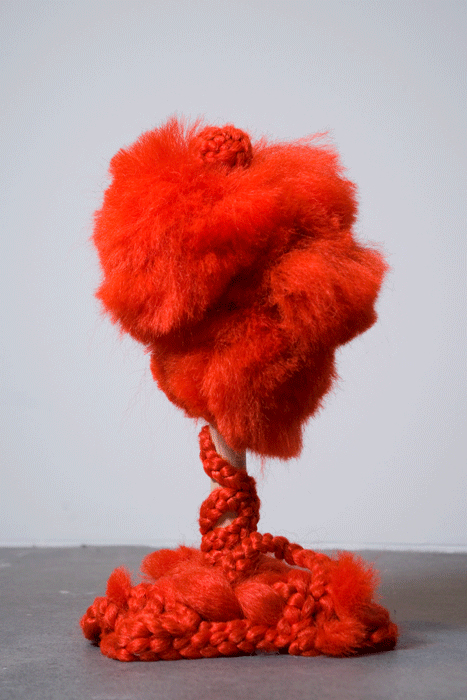
And after making it through the wind tunnel, she emerged somewhat notorious among the hair fetishists of the world. Just kidding. Sort of. A trichophiliac would certainly get titillated from perusing her work. The artist is most famous for her work with hair, both the synthetic and human varieties.
I’m not only working with hair, but it has become popular,Shoplifter admits. It’s a fascinating medium for me.”
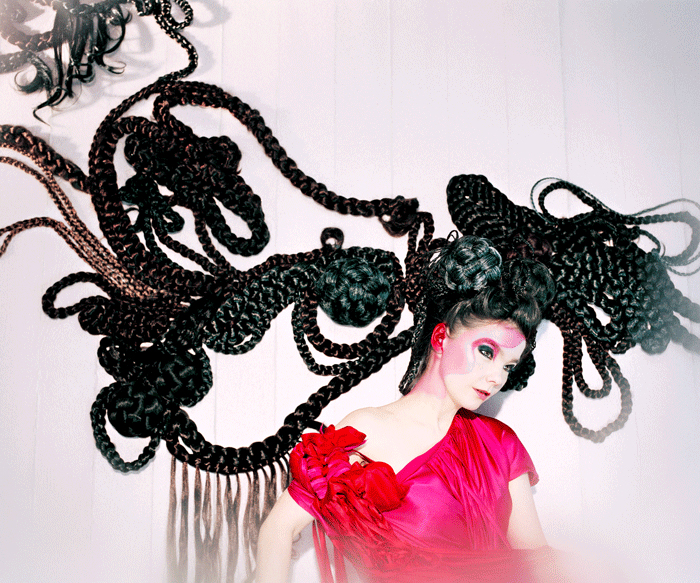
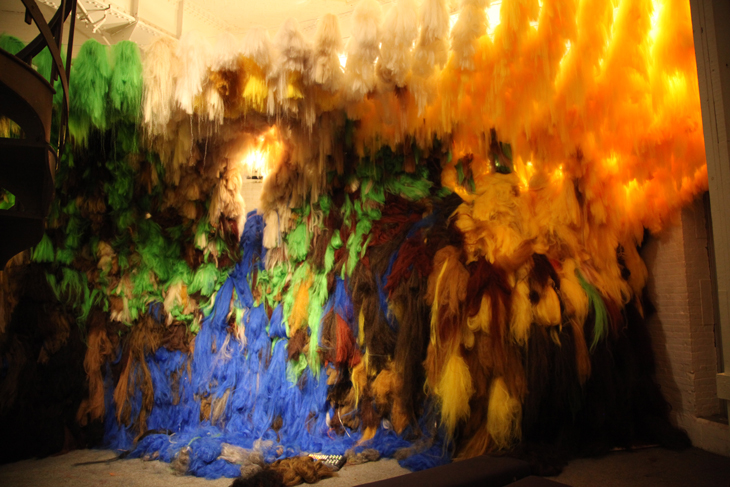
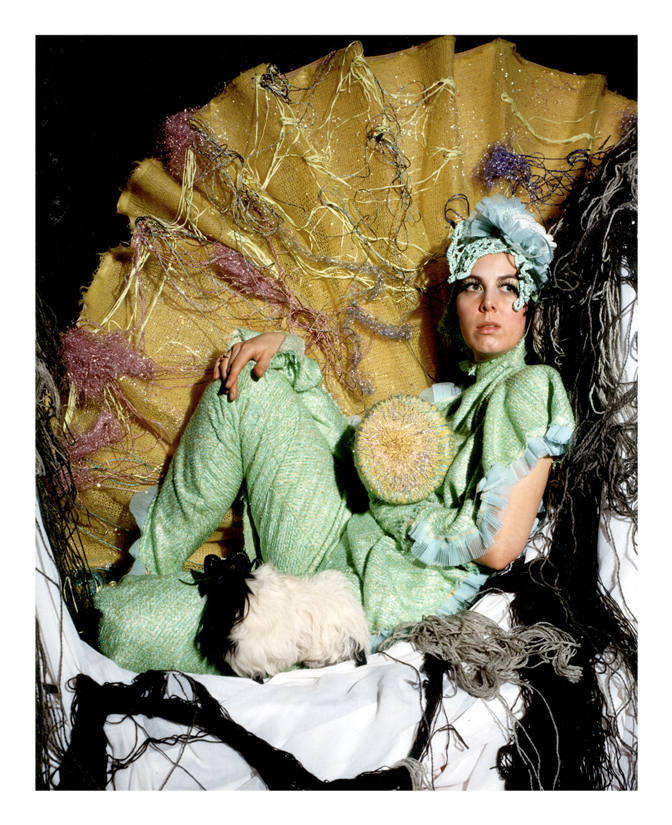
And it’s easy to see why. Sculptures and haute couture gowns knitted, woven, or braided (almost) entirely of hair is different, avant-garde. Each of her pieces is like falling down the rabbit hole into an alternate universe of well, hair: fluffy cotton candy hills and feathered stalagmites reaching for a braided sky. It’s dreamy and hallucinatory, a phantasmagorical eruption of self-discovery and self-absorption.
“A lot of my work is about humanity and fantasy,” Shoplifter explains after I mention that there seem to be common cultural themes in her pieces: a mixture of ethereal beauty, high fashion, and vanity.
Shoplifter’ s work forces the viewer to confront one’s ego, for buried deep within the ruff are questions dealing with personal identity and hypocrisy. Each piece subtly critiques a world consumed with narcissism which isn’t necessarily a bad thing because self-love is love nonetheless and we could all use a little more love, right? It may be naive, but that’s what makes Shoppy’s work so charming. She’s playful and silly, yet somehow weaves the simple desire for beauty throughout her handicraft.
“We all have to deal with our hair and we are constantly trying to contain it. My work is an ode to Scandinavian textiles and working with the threads and fiber to create necessary things and beautiful things. [Scandinavians] have been known to use hair for survival when nothing else was available. I was intrigued by that because when hair is detached from the body it’s disgusting,” she said.
I’m thinking about cleaning the hair out of my shower drain, and I’m gagging over my morning coffee. But taking a look at the artist’s most recent installation, displayed at the Summer Solstice Reyka event on the rooftop of King & Grove in Williamsburg, hair is the most beautiful thing on earth. I want to eat it and roll around and play in it.
“The installation was an homage to the foundation of all life, both beautiful and ugly: the sun,” she said.
Celebrated on June 21st, the holiday Reyka marks the beginning of summer and the longest day of the year. It has a rich history rooted in Scandinavian culture, which is another reason why Shoplifter was drawn to working on the project. That and the vodka. Again, kidding. Sort of.
“I wanted to recreate something intrinsic with Iceland and its culture, Shoppy explains, “The sun became the focal point of the entire event. It just makes sense to have the presence of the sculpture made out of neon hair; there’s a presence and energy in a ball of fire. It’s euphoric and there’s just so much energy from having the sun out all the time. People coming together and drinking and partying into the night”.
RULE #4: KNOW SOMEONE FAMOUS
REPLACE IT WITH: COLLABORATE WITH SOMEONE
Shoplifter has had installations all around the world. “I’ve lived in a trailer for a PS1 MOMA colony project and I’ve had a solo exhibition in a gallery in London,” and she’s collaborated with a number of famous artists and designers, the most notable of which include Victoria Bartlett’s fashion label, VPL, and Shoppy’s singer/songwriter counterpart,Bjjork on multiple occasions.
Confession: I listened to Bjork while flipping through an archive of Shoppy’s past work before sitting down to encapsulate her life and soul. The combination of my three cups of iced coffee, neon-colored and pastel-tinted hair, and Bjork’s surrealist notes wafting in the background made for the most beautiful alien abduction scene. It was kind of like reading a Jane Austen novel from the future where cyborgs fall in and out of love and Sigmund Freud psychoanalyzes the blend of conscious, unconscious, and self-conscious love-making.
“It’s very high profile,” Shoppy says about joining forces with a musician with a Twitter following of 458,348. “Bjork’s fascinating because I’m inspired by identity and vanity and pop culture.”
Which makes sense because our hair is a large part of our individuality and pride. We have the option to tame it, grow it, dye it, brush it, tease it. It’s an extension of our identity that allows us to distinguish ourselves from one another.
Her art, her livelihood, her collaborations, whether in fashion, music, or with other visual artists feed Shoppy’s inner animal. They may satiate her appetite for a while, but she will always be on the hunt for more.
“A collaboration is about finding new ways to do something creative in the collective and I like that’s to get into another’s head,” she said.
It’s a classic case of putting things into perspective. Shoplifter is continually experiencing identity growth, whether it be through her original pieces, or teaming up with other artists. She thrives on creating and sharing the beautiful with the ugly, a sweet juxtaposition she can achieve only by working with an ugly medium to make a beautiful piece of art. Her work has collided with reality to form a personal concept of opposites, extremes, and exploring other worlds, even if it’s just the one in her own head.
So sure, maybe John will get promoted before Caoimhe (KEE-Vah), merely because his supervisor can pronounce his name without looking up the pronunciation.
But Hrafnihildur Arnadottier, or Shoplifter, or whatever you want to call her (Hair Girl? Trich Bitch?) is a success no matter what her name is.
Because sometimes, you can’t always believe everything you read on the Internet. (Oh the irony!) But just in case you don’t believe me, do a bit of your own digging.
Dawn. The wondrous vibrancy of the Atlantic coast. Colors abound.
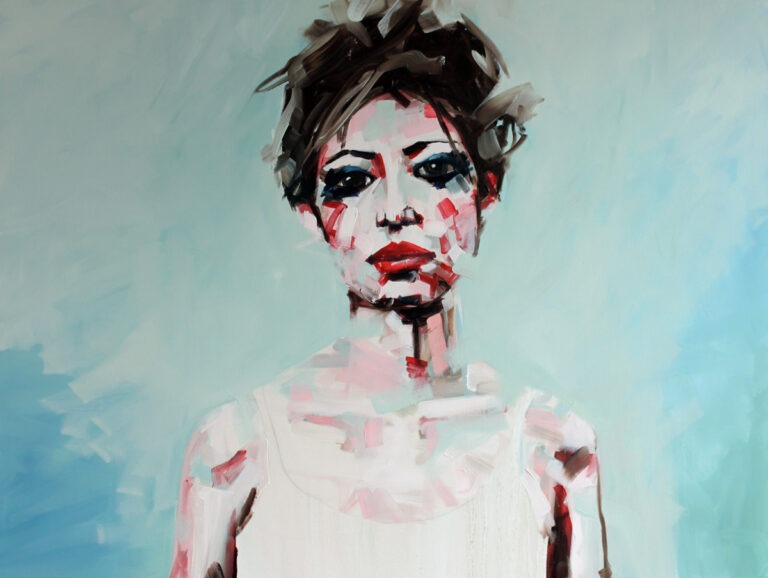
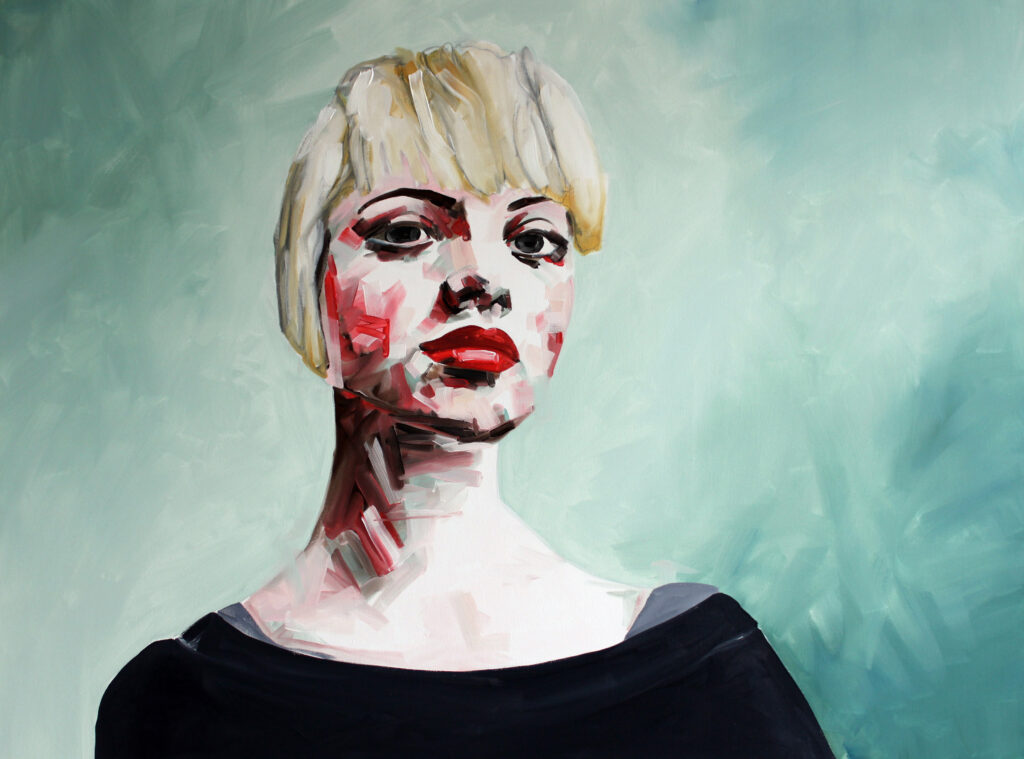
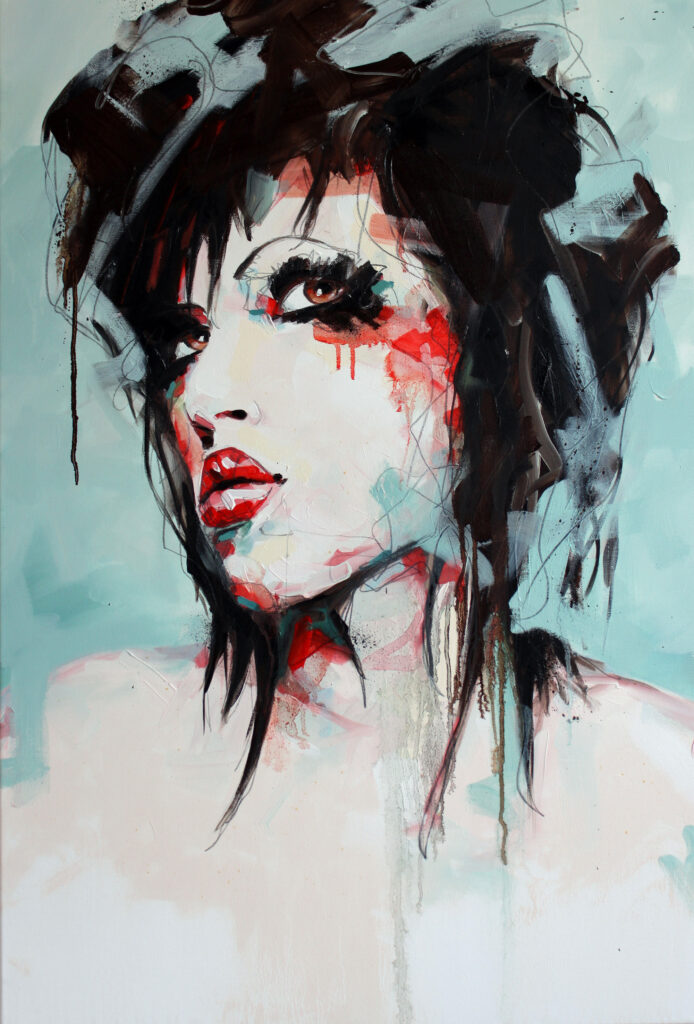
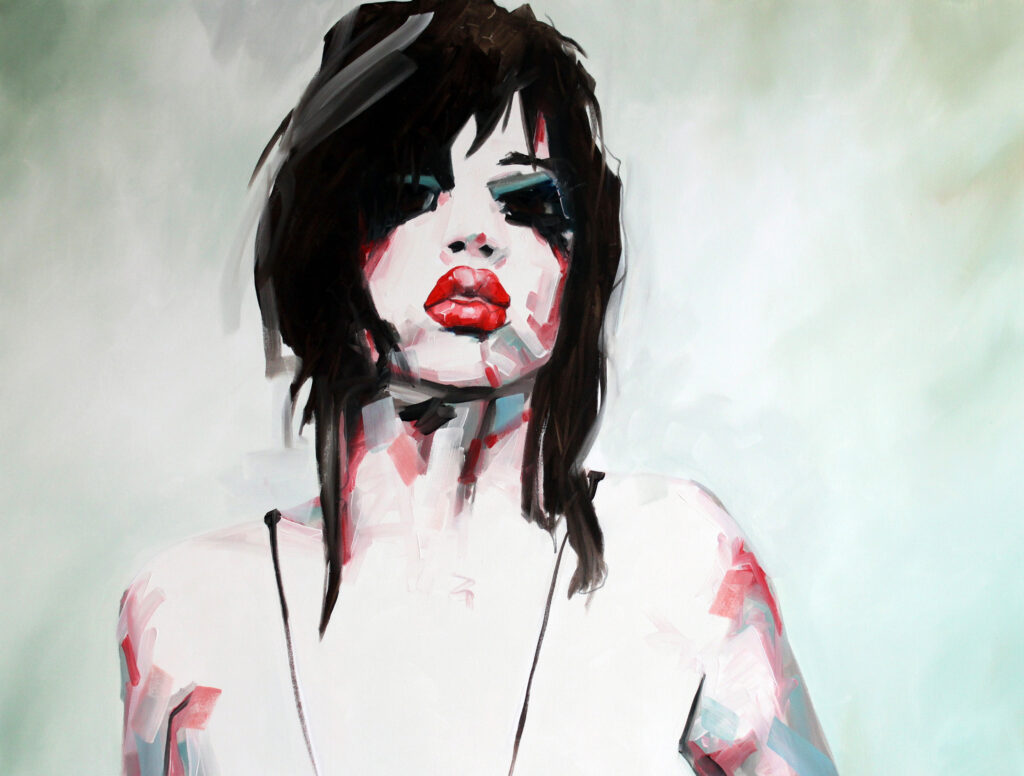
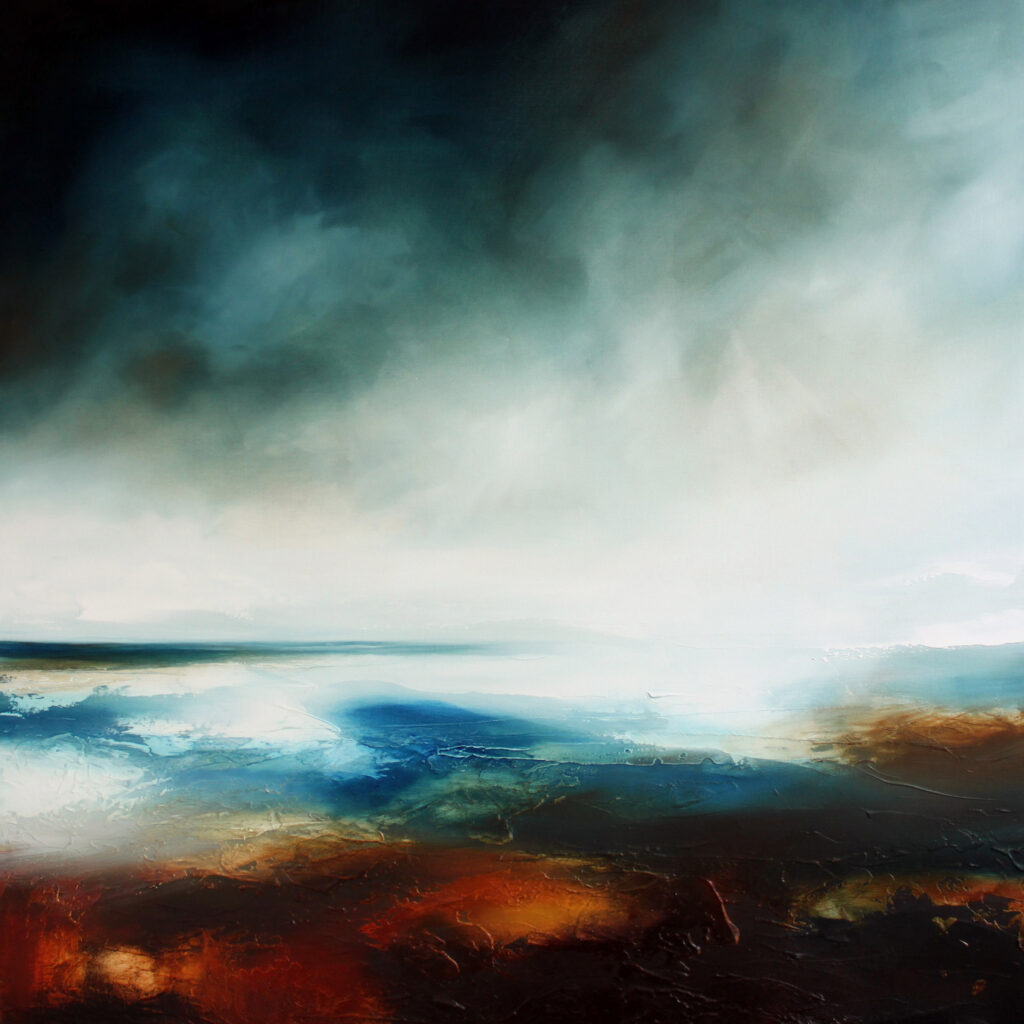
Isolated, wandering in the rich wilderness, Paul Bennett stops to bear witness. In a moment, the sun breaks through a castle of clouds, creating a magnanimous display that is imprinted on his painter’s mind. He has ventured here to discover all this sheer beauty, nature’s landlord.
In a rare opportunity, I catch Paul in between canvases. He is currently working on a new figurative piece, a stark departure from his abstract seascapes. I ask the most obvious question that comes to mind:
Why art, painting?
I’ve always been creative, whether that was with words, music or visually. Street art was my first encounter with the visual arts. That and album covers.
I had no direction once I left school. After a couple of years I signed up to a part-time college course in Art and Design. I had some great tutors and everything just clicked into place. The most important thing that really got me going was the freedom involved and the chance to explore and break boundaries. Art school was a bit stricter and the main focus was more centered on conceptualism, which is not really my thing. I had no ambition to try and be the smartest guy in the room or to give the super rich something to talk about while stuffing swan down their throats.
After leaving education I fell into graphic design for a while and it took seven years for me to get back in the painting studio. I’ve never looked back. But why painting? Why not? We’ve all got to make decisions, at points in time, and painting just happened to be mine. The key is to keep at it if you love it.
It’s quite evident that creativity resides well in Paul. I inquire about his particular style.
I work in two or three different styles, figurative, semi-abstract seascape, and abstract. The figurative is the one I find the most challenging, but the most rewarding. It’s also the subject that is seen (from the outside) as being more contemporary and provocative. The audience and response to the portraits is a lot different to that of my other styles.
The abstract paintings offer their own set of challenges and I was attracted to this style because it is more approachable. The abstract work is also more focused and suitable for a more corporate market as well as the home. It also offers more diversity with scale. The best thing is having a variety and being able to jump from one the other. It keeps it all fresh.
I’m always interested in how artists work, what makes their process special.
The tools I use are pretty standard. Brush, canvas, knife and oil, and occasionally gloss resin. I like to create a lot of texture but balance that out with calmer and flatter space. The most important thing is to just get stuck into the canvas. Just create. The rest will follow. Plenty of tea and the radio switched on is also a must.
What is your inspiration? I ask, and without skipping a beat his response is as brilliant as his work. [Is it brilliant if he’s just quoting Close? Another artist quoted Close last issue, I think.]
Inspiration is not really part of how I work. I will go and visit locations to get a feel for a place, but the work produced is a product of the process. I think Chuck Close sums it up better than I ever could:
The advice I like to give young artists, or really anybody who’ll listen to me, is not to wait around for inspiration. Inspiration is for amateurs; the rest of us just show up and get to work. If you wait around for the clouds to part and a bolt of lightning to strike you in the brain, you are not going to make an awful lot of work. All the best ideas come out of the process; they come out of the work itself. Things occur to you. If you’re sitting around trying to dream up a great art idea, you can sit there a long time before anything happens. But if you just get to work, something will occur to you and something else will occur to you and something else that you reject will push you in another direction. Inspiration is absolutely unnecessary and somehow deceptive. You feel like you need this great idea before you can get down to work, and I find that’s almost never the case.
 Naturally, I wonder how he sees how his work differs from his contemporaries.
It’s important for the work to be unique, but where the uniqueness comes from, well I’m not sure. I try to get a result that comes direct from myself rather than external influences. The journey I take when painting is to get Informed and motivated from what I have previously created. A single mark might be all it takes to dictate a whole piece of work or even a series. However, I am beginning to notice that I might be inspiring other artists a little too much, as I am beginning to see work that is very similar to my own. Probably unavoidable in this day and age, unfortunately.
Such an aware artist, surely Paul has some advice to extend to emerging artists worldwide.
Just keep at it and get the work in front of as many people as possible. Marketing is a very important part of the job. Just like any other carrier or industry, you have to get out of your comfort zone and put yourself in situations and places that are not quite natural to you. Also, create something that is yours. It’s important for the artist as well as the audience to know that they are looking at something that only you would have created.
And the future?
To be honest, I have no idea. I think that’s up to other people to decide. I just have to keep on doing what I’m doing until I do something else.
By Paul BennettBy Paul BennettBy Paul BennettBy Paul Bennett
For more about Paul, visit his website – paul-bennett.co.uk